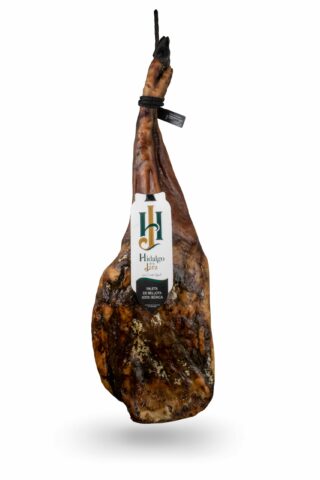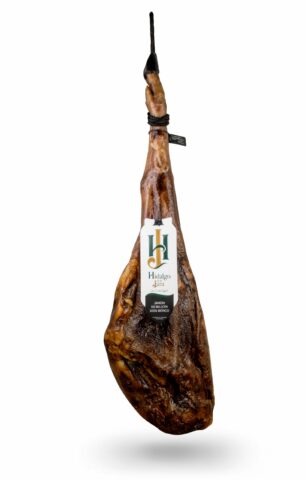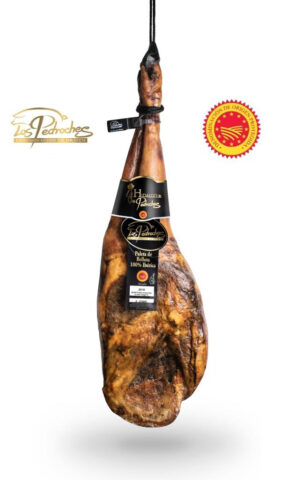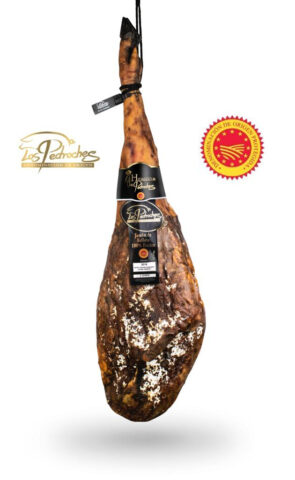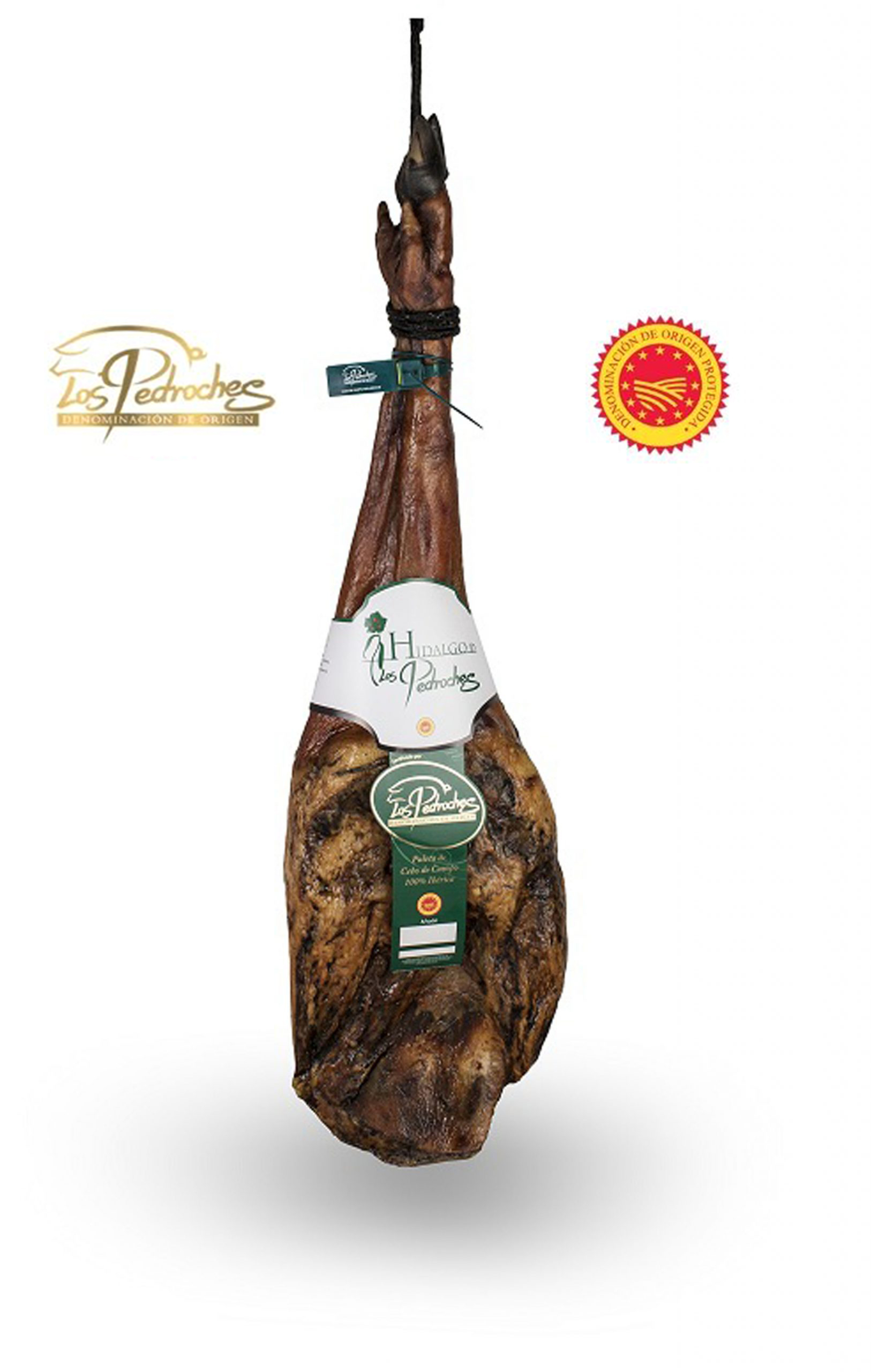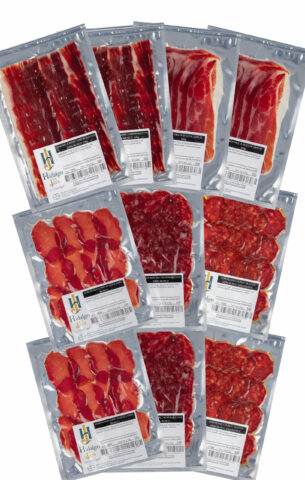
Buying a bone-in whole ham or boneless Iberian ham does not by itself change the quality category of the raw material. An excellent ham can be sold in either format. What changes is storage, carving, usable yield and convenience. The best choice has less to do with which looks more traditional and more with how, where and how quickly you will eat it.
A bone-in ham keeps the original shape of the hind leg and supports traditional carving on a ham stand. A boneless ham has been prepared after curing: the bones are removed and the meat is normally pressed or shaped into a stable block. This adds convenience but changes the carving experience.
What “boneless” actually means
Removing the bones does not mean turning ham into reconstructed or processed meat. In a properly prepared boneless ham, you still have the cured muscles of the original leg; the bones have simply been extracted and the piece conditioned into a form that is easier to handle and slice.
Producers may sell the boneless ham as one block, halves or smaller pieces. Vacuum packing is common for protection during storage and transport. Always follow the label once the package is opened.
The major advantage of bone-in ham: the carving experience
For many people, keeping a ham on a stand, discovering its different areas and carving each serving is part of the pleasure. Maza, babilla, punta and hock vary in fat and texture, and working through them teaches you how the leg changes.
Hand carving lets you adjust thickness and direction to each section. It also needs time, suitable knives and practice. If you enjoy the ritual, the bone is not a disadvantage; it is part of the product experience.
Our guide to carving and using a whole Iberian ham at home covers the process from beginning to end.
The major advantage of boneless ham: convenience and space
A boneless block fits much more easily into refrigerators, cold rooms and small kitchens. It does not require a traditional ham stand and can be sliced with a knife on a board or with a suitable slicing machine.
This is useful for households that do not want a whole leg on display for weeks, for hospitality operations that need regular slices, and for people with a good domestic slicer. The uniform geometry makes portioning predictable.
Yield: the bone weight has already been removed
When you buy a bone-in leg, some of the total weight is bone, rind and external fat that will not become serving slices. This is normal and part of the real yield of whole ham.
With a boneless piece, the producer has already removed much of that material before sale. You therefore cannot compare the price per kilogram of boneless and bone-in ham as if each kilogram represented the same amount of sliceable food. A kilogram of boneless ham contains a much higher proportion ready to portion.
Our guide to the real yield of a whole Iberian ham explains why starting weight and final sliced weight are different.
Does bone-in ham taste better?
There is no universal rule. Flavour is primarily established by raw material and curing before the format is changed. If two formats begin with the same ham, competent boning does not suddenly turn a great product into an inferior one.
What does change is how the ham evolves after opening. A whole bone-in leg remains a thick structure and exposes mainly the area being carved. A boneless block can have more cut surfaces when divided or handled, so protection and storage become particularly important.
Storing a bone-in ham
Before carving, keep the ham under the conditions recommended by the producer: generally protected from excessive heat, moisture and direct light. Once opened, the cutting face needs protection from dirt and excessive drying without trapping unsuitable moisture.
Consumption frequency matters. Carving small quantities regularly refreshes the surface. Our dedicated guide to storing a whole ham before and after opening covers the subject in detail.
Storing boneless ham
Boneless ham is commonly vacuum packed. While sealed, follow the manufacturer's temperature and date instructions. Once opened, protect the block from air, use clean utensils and refrigerate when the product label requires it.
Dividing a large boneless ham into separately protected blocks can be practical for slow consumption because only one section is opened at a time. Do not improvise unsafe repacking: the convenience of the format depends on hygienic handling.
Knife versus machine slicing
A bone-in leg is built for traditional carving with a long flexible knife, constantly adapting to anatomy. Boneless ham is especially suited to a slicing machine, which can produce regular slices rapidly and at a controlled thickness.
Neither method is automatically superior. Hand carving provides an artisanal experience and adapts to changing fat and fibre; a well-operated machine offers speed and consistency. Our comparison of hand-sliced versus machine-sliced Iberian ham examines that question separately.
Space and equipment
A bone-in ham needs a stable stand, enough working room and appropriate knives. In a very small kitchen this can be inconvenient.
Boneless ham occupies far less storage space. A slicing machine itself can be bulky, but if you use a knife and board the required equipment is minimal.
For a household that eats little ham
If you eat ham occasionally, smaller boneless blocks or pre-sliced vacuum packs may reduce waste and simplify storage. Buying a large bone-in leg purely because it is traditional makes little sense if it will take too long to finish.
If learning to carve is part of the goal, however, a whole ham may easily justify the space even in a small household.
For families and gatherings
A whole ham works very well when several people eat from it regularly over a period of days or weeks. It can also become part of the service at celebrations. When you need many consistent slices quickly, boneless ham and a good slicer may be more efficient.
The choice is therefore partly culinary and partly logistical.
As a gift
A whole ham has strong visual and ceremonial presence. For a recipient who knows how to carve and enjoys the ritual, it can be a memorable gift. Giving a bone-in leg to someone with no stand, knives or regular ham habit can instead create work for them.
A high-quality boneless block or a selection of sliced packs can look less dramatic on arrival but prove much more useful during the following weeks.
A simple decision rule
- Choose bone-in if you value traditional carving, eat ham often, have the space and want to experience every area of the leg.
- Choose boneless if convenience, compact storage, consistent slicing and high usable yield per purchased kilogram matter most.
- Choose pre-sliced if consumption is occasional or you want ready-to-serve portions.
After choosing the format, compare the actual category, breed, feeding system, producer and curing. Format does not replace raw-material quality.
Frequently asked questions
Is boneless ham lower quality?
Not by definition. It can come from exactly the same type of high-quality leg. What matters is the ham that was boned and how it was handled afterwards.
Why can boneless ham cost more per kilogram?
The displayed kilogram contains much less non-sliceable weight. Proper comparison needs to account for the bone-in leg's real edible yield.
Can I hand-slice boneless ham?
Yes. A slicer gives consistency, but a sharp knife and stable board can produce excellent slices.
Which stores better?
It depends on packaging and consumption rate. A bone-in leg exposes its surface progressively; sealed boneless ham stores compactly under its specified conditions. Once opened, both require careful handling.
Browse the ham and shoulder formats currently available at El Mercado de Origen.
-
EMDO Selection SaleSale!
 Select options
This product has multiple variants. The options may be chosen on the product page
Select options
This product has multiple variants. The options may be chosen on the product page
-
EMDO Selection SaleSale!Select options
This product has multiple variants. The options may be chosen on the product page
-
EMDO Selection SaleSale!Select options
This product has multiple variants. The options may be chosen on the product page
-
EMDO Selection SaleSale!Select options
This product has multiple variants. The options may be chosen on the product page
-
Sale!Select options
This product has multiple variants. The options may be chosen on the product page