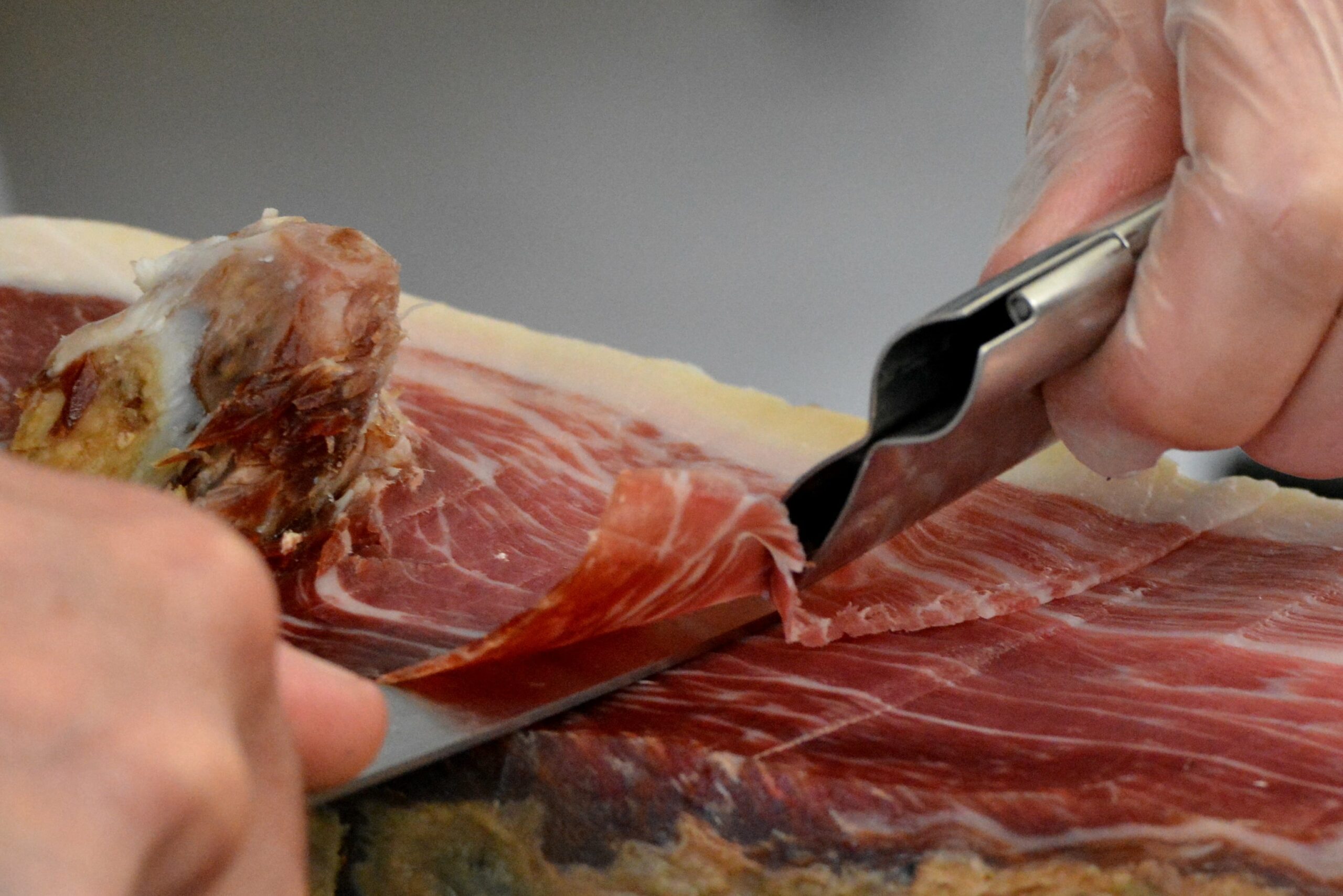
When buying a whole Iberian ham, it is natural to translate its weight into something practical: how many packs of sliced ham will it actually produce? The calculation is never simply “whole-leg weight divided by 100 grams”. A significant part of the ham is bone, hoof, rind, external fat and tissue that will not become serving slices. Yield also varies with the shape of the piece and the way it is carved.
As a practical guide, a bone-in ham often gives an edible slicing and trimming yield of roughly 40–45%. Individual hams and carving services may fall above or below that range. Treat it as a planning range, not as a guarantee.
What does ham yield mean?
Yield is the share of the original weight that ends up as usable edible product. If an 8 kg ham gives 3.4 kg of slices and useful trimmings, its yield is 42.5%. The remainder is not necessarily all waste: bones can be used in cooking and some fat or trimmings have culinary uses, but it is not the sliced ham people usually picture when they see the gross weight.
Definitions also differ. Some carvers include cubes and usable offcuts in their yield figure, while others report only the meat packed as slices. Two percentages can therefore look different even when the overall use of the ham is similar.
How many 100 g packs by whole-leg weight?
If we apply a 40–45% planning range and imagine that all of that usable yield were packed into exact 100 g portions, the calculation looks like this:
| Whole ham weight | Yield at 40% | Yield at 45% | Equivalent 100 g packs |
|---|---|---|---|
| 7 kg | 2.8 kg | 3.15 kg | 28–31 packs |
| 8 kg | 3.2 kg | 3.6 kg | 32–36 packs |
| 9 kg | 3.6 kg | 4.05 kg | 36–40 packs |
| 10 kg | 4 kg | 4.5 kg | 40–45 packs |
This is a mathematical illustration, not a commercial promise. A real carving service may produce fewer slice packs because some usable meat becomes cubes, dry edges are trimmed, packs contain slightly more than 100 g or the carver prioritises a particular presentation. This is why commercial estimates for 7–8 kg hams often sit around 25–30 packs, while larger pieces may be quoted around 30–35 or more.
A realistic example with an 8 kg ham
Take an 8 kg piece. At 40% yield it provides about 3.2 kg of usable product; at 45%, about 3.6 kg. If absolutely all of it became exact 100 g slice packs, the theoretical result would be 32 to 36 packs. In practice, some meat may be packed as cubes and some dry or external material may be removed, so the number of slice packs can be lower.
If a carving service returns 30 packs plus several packs of cubes and sawn bones, that does not necessarily mean product has been lost compared with a 34-pack estimate. Compare the total net edible weight returned, not just the number of envelopes.
Why two 8 kg hams can yield differently
Gross weight does not tell you the exact ratio of bone, fat and lean. Two 8 kg hams can have different conformation, external fat cover and degrees of dehydration. One may be long and slender, another broader or fattier. Natural variation exists even within the same producer and category.
Curing matters too. Ham loses water over months or years and that loss is essential to its transformation. A long-cured piece should not be judged only by final weight; texture and the balance between lean and fat are part of the value.
Bone is a significant part of the weight
The femur, tibia and other bones account for a meaningful proportion of the whole piece. They cannot become slices, but they need not be thrown away. A carving service can saw and pack them for stocks, beans and stews. That increases the culinary use of the purchase even though it does not increase “slice yield”.
Our guide to using Iberian ham bones and trimmings explains how to make the most of those parts.
Rind and external fat
To reach the lean meat, rind and varying amounts of yellow or external fat must be removed. Not all fat should disappear: clean white fat attached to the slice is a central part of Iberian ham's texture and flavour. Good carving removes what should not be served while retaining the fat that belongs in the eating experience.
Over-trimming can reduce yield unnecessarily. Under-trimming may leave unpleasant flavours or textures. The judgement of the carver therefore influences both quality and final yield.
Carving technique changes the result
A skilled carver maintains a stable cutting surface, works accurately around the bones and makes cubes from areas where clean slices are no longer possible. An inexperienced home carver may leave more meat attached to the bone or produce overly thick slices that are hard to portion evenly.
This does not mean professional carving is mandatory. If you enjoy working through a whole ham and eat it regularly, learning the technique is part of the appeal. If your priority is predictable packs and high recovery, a professional service may be worth its cost.
Do ham and shoulder have the same yield?
No. A shoulder has different anatomy and generally contains more bone relative to its weight. Its percentage yield is therefore usually lower than that of a ham. Market guidance often places shoulder yield around 35–40%, although individual pieces again vary.
This is why comparing only price per gross kilogram of a shoulder and a ham can be misleading. If you want a true edible-cost comparison, expected yield must be included.
How to calculate cost per usable kilogram
Divide the total purchase price by the estimated usable kilograms. If an 8 kg ham costs €240 and you expect 3.4 kg of edible slices and trimmings, the approximate cost is €70.59 per usable kilogram before any carving fee. This makes comparison with ready-sliced packs much fairer.
Add a carving charge if applicable and check whether the service includes vacuum packing, cubes, bones and shipping. A cheaper headline carving fee may be less attractive if important parts are not returned.
How many people does one pack serve?
A 100 g pack can be a generous portion for one person when ham is the focus, or serve two or more as part of an aperitif with other foods. Turning a whole ham into a number of guests therefore depends on the occasion. For four people, 150–250 g can be enough for an appetiser depending on the rest of the meal; a dedicated tasting may call for more.
Planning in grams helps avoid opening too many packs. Iberian ham is aromatic and rich, and a moderate quantity served at the right temperature is often more enjoyable than a large pile of cold slices.
What to ask a carving service
Ask whether packs are 80, 100 or 150 g; whether cubes are returned separately; whether the bones are sawn and included; whether slices are vacuum packed; and whether the fee is per piece or by weight. Find out whether a quoted pack count is guaranteed or simply an estimate.
The most transparent result is a summary of total net weight returned. That lets you assess the yield of your actual ham instead of comparing generic claims.
A quick rule for planning
For a bone-in ham, multiply gross weight by 0.40–0.45 to estimate usable kilograms, then multiply those kilograms by ten for a rough number of 100 g portions. Example: 8.5 kg × 0.40–0.45 = 3.4–3.825 kg, or about 34–38 theoretical 100 g portions before separating cubes and other trimmings.
Use this as a budget, not a promise. When browsing our hams and shoulders, check piece weight, format and whether carving and packing are available. Those facts make a much better comparison than gross weight alone.
Frequently asked questions
Does an 8 kg ham make 80 packs of 100 g?
No. That ignores bone, rind and external fat. At an indicative 40–45% yield, the theoretical equivalent is closer to 32–36 packs.
Why did my carver return fewer packs than I calculated?
Some meat may be returned as cubes, individual packs may be heavier than the nominal target, or the ham may simply have a lower yield. Ask for total net edible weight.
Does a larger ham always yield a higher percentage?
Not necessarily. Gross size helps, but conformation, bone and fat ratios and carving technique can still produce different percentages.
Do bones count as yield?
Not as sliced-ham yield, although they remain valuable in stocks and stews when handled and stored appropriately.
-
-
EMDO Selection
-

.jpg)