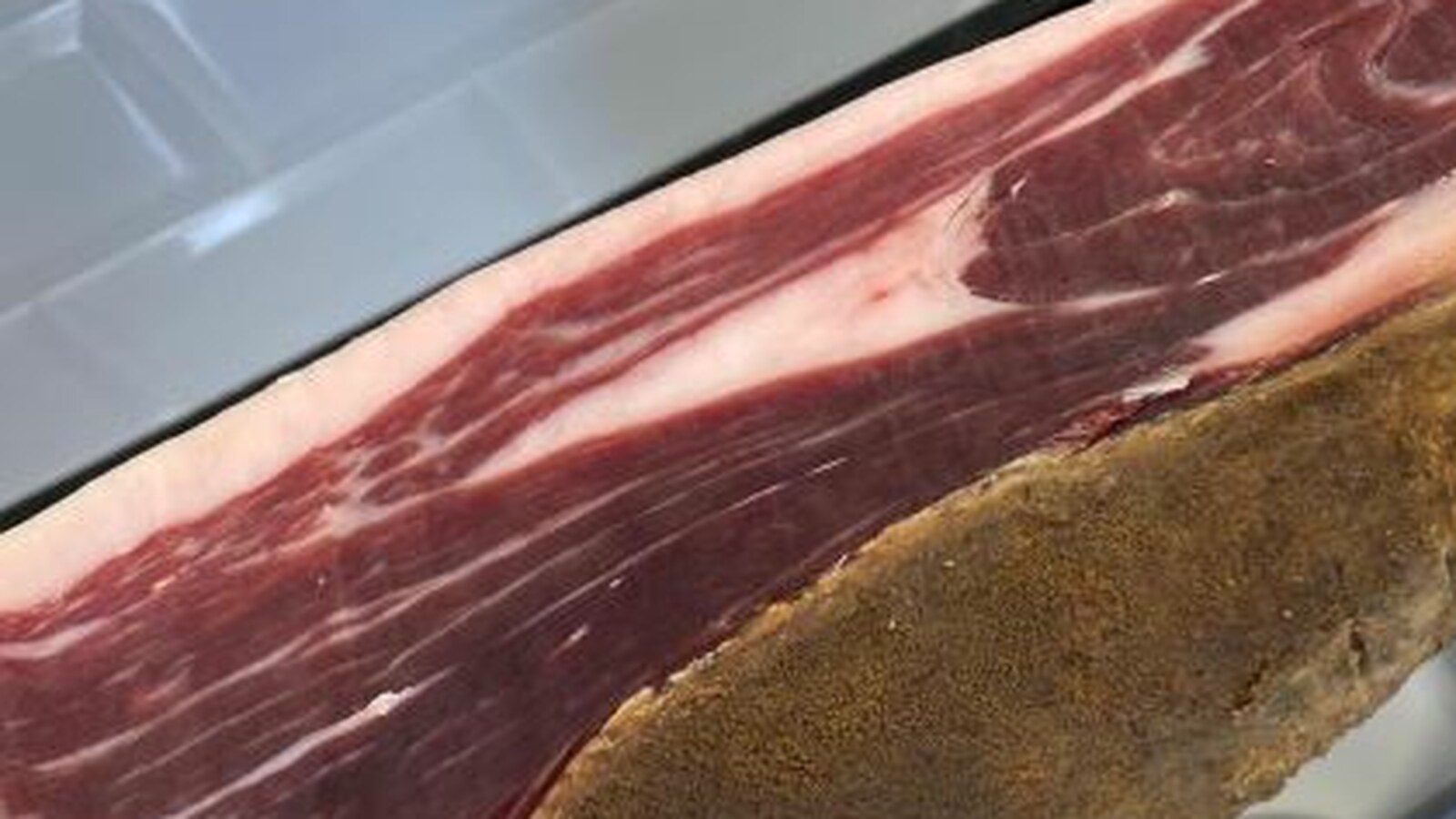
It is easy to think of a whole ham as one uniform product, but carving tells a different story. A single leg contains muscles with different shapes, fat distribution, exposure to air and curing rates. A slice from the maza can therefore feel very different from one cut from the babilla or the punta, even though both come from the same ham.
Understanding these zones is not just professional vocabulary. It helps you decide which side to start, understand changes in texture as carving progresses, reduce waste and choose which slices are best served alone and which trimmings are better used in cooking.
The maza: the broadest and most familiar section
The maza is the largest part of the ham. On the stand it is usually the wider, more rounded face. It provides a large amount of meat and, in well-infiltrated pieces, visible fat that contributes juiciness and allows broad slices. It is the area many people associate with the classic slice: thin, relatively large and balanced between lean meat and fat.
Because the maza has more muscle mass, moisture is retained differently from narrower areas. That changes the mouthfeel. It does not mean the maza is automatically the best section; it simply has a particular profile and usually gives a high carving yield.
The contramaza: continuity with its own nuances
The contramaza lies close to and opposite the maza. Professional anatomical descriptions can group individual muscles slightly differently, but the practical lesson is that one zone does not suddenly become another. As the knife advances, fibre direction, visible fat and slice shape gradually change.
This is why the cut should follow the bone and adapt to the leg rather than trying to preserve one perfectly flat plane at all costs. Forcing a flat surface can leave useful meat around the bone and increase waste.
The babilla: narrower and usually more cured
The babilla is the narrower face of the leg. It has less external fat protection and less overall mass than the maza, so it commonly cures more quickly and develops a firmer texture. It may feel more concentrated and less fatty, although the exact result depends on the individual ham.
This difference explains the practical rule about how to start a ham. If the leg will be eaten slowly, starting on the babilla can make sense because that already-firmer side will not spend weeks drying further while the maza is consumed. For rapid consumption, many people begin with the maza. See our guide to starting a ham hoof up or hoof down.
The punta: fat, concentration and a different geometry
The punta is at the end opposite the hoof, close to the hip. It is anatomically irregular, with bone and pockets where fat can be particularly important. Slices are often smaller and the sensory profile can differ from the maza.
Once you reach the punta, precision matters more than producing large slices. Follow the natural shape of the leg. Good trimmings that cannot become elegant slices still have real culinary value in eggs, vegetables, croquettes, broths and stews.
Jarrete and shank: small muscles with concentrated character
The area near the hoof contains smaller, firmer muscles. The jarrete usually produces small pieces and cubes rather than long slices. It is especially useful in cooking because the meat is flavourful even when its geometry is unsuitable for classic carving.
When thin slicing is no longer practical or safe, change the objective. Remove usable cubes, clean the bones and save them for stock. Proper utilisation does not mean forcing a ham to produce traditional slices from every last centimetre.
Why flavour changes within one ham
Perceived flavour depends on several interacting factors: fat distribution, water content, concentration during curing, slice thickness, serving temperature and the ratio of lean meat to fat in each bite. Because the anatomy is not uniform, the sensory experience is not uniform either.
Fat also affects texture and aromatic persistence. If the ham is served too cold, some differences can be muted because the fat remains firm. Allowing the product to reach an appropriate serving temperature helps the texture become more expressive.
Fibre direction matters when carving
A good slice is not only thin. Knife direction and leg stability influence how it feels when eaten. As different muscles and bones appear, an experienced carver subtly changes the angle rather than following one rigid direction.
The aim is not a geometrically perfect surface. It is to obtain safe, thin slices with a good balance of lean and fat whenever the section allows it.
How to recognise a change of section
You do not need to memorise an anatomical diagram. The signs are visible: the carving surface narrows, new bones appear, fat distribution changes, the meat becomes firmer and slices change shape. At that point, reduce the length of each knife stroke and work more carefully.
For the complete process, see our guide on how to carve and use a whole Iberian ham, which covers tools, carving order and trimmings.
Which part is the best?
There is no universal answer. The maza is prized for juiciness and easy carving; the babilla can appeal to people who prefer a firmer, more concentrated texture; the punta has its own character; and the jarrete is extremely useful in the kitchen. Part of the pleasure of a whole ham is precisely that it evolves.
Instead of searching for one superior zone, compare them. Serving slices from two different sections side by side makes it easy to understand how anatomy and curing shape the final product.
Related hams and shoulders
-
EMDO Selection SaleSale!
 Select options
This product has multiple variants. The options may be chosen on the product page
Select options
This product has multiple variants. The options may be chosen on the product page
-
EMDO Selection SaleSale!Select options
This product has multiple variants. The options may be chosen on the product page
-
EMDO Selection SaleSale!Select options
This product has multiple variants. The options may be chosen on the product page
-
EMDO Selection SaleSale!Select options
This product has multiple variants. The options may be chosen on the product page
-
Sale!Select options
This product has multiple variants. The options may be chosen on the product page


 12 Jars of Pepper Jam, 250 ml