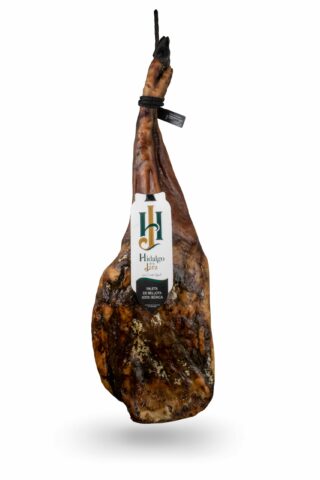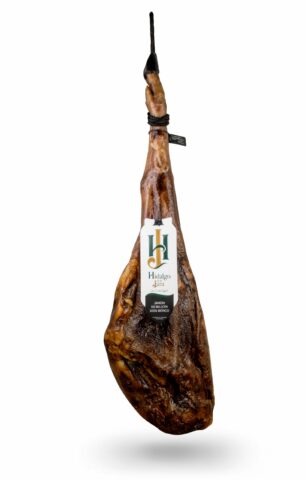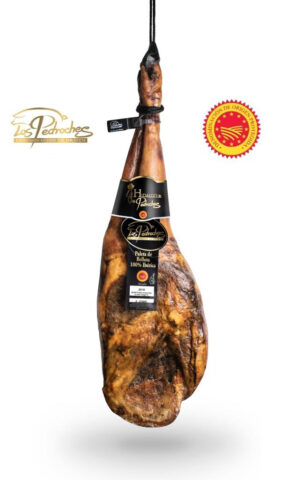
Iberian ham and Serrano ham are two major families of Spanish dry-cured ham, but their names are not two grades on the same ladder. “Iberian” is linked to pig breed and a specific regulated production system, while “Serrano” identifies a traditional cured-ham product with its own requirements. Looking only at colour, curing time or price can therefore be misleading.
The useful question is not simply which is better, but what you are buying and what experience you want. Someone may choose good Serrano for sandwiches and everyday cooking while reserving acorn-fed Iberian ham for eating on its own. Both choices can be sensible.
The first difference is the pig
For Iberian ham, the percentage of Iberian breed is part of the commercial designation. Products may be 100% Iberian or carry another permitted breed percentage stated on the label. You cannot reliably determine that percentage from hoof shape or meat colour.
Serrano ham is produced outside the Iberian breed system. Different white-pig lines and crosses can be involved, so “Serrano” should not be treated as the name of one single pig breed.
Feeding and production system also matter in Iberian ham
Spanish Iberian quality rules distinguish categories linked to feeding and management. This is where terms such as bellota (acorn-fed), cebo de campo (field-feed) and cebo (feed) come from, combined with the relevant breed information.
Not all Iberian hams are therefore equivalent. Comparing “Serrano versus Iberian” without specifying the Iberian category is very broad. A feed-category Iberian ham and a 100% Iberian acorn-fed ham belong to the same regulatory family but do not come from the same production system.
Our guide to what 100% Iberian acorn-fed ham really means explains the terminology in detail.
Fat is one of the most obvious sensory differences
Iberian pigs have a strong tendency to deposit intramuscular fat. In a well-made ham, that marbling appears between muscle fibres and contributes to a supple texture and distinctive melting sensation. Genetics, feeding and the animal's activity all influence how the fat develops.
Serrano ham can certainly be juicy and contain good external fat, but intramuscular distribution and melting behaviour are generally different. This helps explain why many Iberian slices appear glossy and soft when served at an appropriate temperature.
Is Iberian ham always cured for longer?
Iberian hams are often large pieces with a fat composition well suited to long maturation, and many producers age them for years. Nevertheless, more months do not automatically mean higher quality. The appropriate maturation period depends on the individual piece, weight and process.
Serrano ham also passes through salting, resting, drying and maturation. Its time depends on weight, raw material, processing and commercial class. A curing-duration number on its own cannot tell you which of two hams was made better.
How flavour tends to differ
A mature Iberian ham can offer deep aromas, melting fat, long persistence and clear variation between different areas of the leg. Acorn-fed products can add characteristics linked to montanera production and lengthy maturation.
Serrano often presents a more direct profile of cured meat, salt balance and maturation aromas, usually with less melting fat. There are major differences between producers, however. “Iberian strong, Serrano mild” is far too crude a rule.
Colour cannot identify a ham reliably
Iberian ham can range from red to deep red, while a Serrano can also have an attractive dark colour after good maturation. Lighting, cutting area, surface oxidation and moisture all affect appearance.
Do not pay a premium simply because an online photograph looks darker. The legal product name, traceability, producer information and label tell you much more than the colour of one slice.
“Pata negra” does not simply mean a black hoof
The expression “pata negra” has a regulated use within the Iberian system and should not be treated as a casual synonym for any dark-hoofed ham. Non-Iberian pigs can have dark hooves, and external appearance cannot reveal the complete category of an Iberian product.
Labels and official identification are more useful. Read the declared breed percentage and feeding category instead of trying to authenticate a ham by sight alone.
Price: what are you paying for?
Final price reflects rearing time, feed, land requirements, carcass yield, piece weight, moisture loss during curing, cellar time, selection and producer positioning. In certain Iberian categories — particularly acorn-fed systems — production uses substantially more time and extensive resources.
This is why an Iberian ham can cost several times more than a Serrano without price per kilogram telling the full story. It does not mean every meal needs the more expensive product. Good Serrano can be a logical choice for daily sandwiches, croquettes or cooking. When the slice itself is the centre of a tasting, the sensory profile of Iberian ham may justify the higher cost.
Choosing when the ham will be eaten on its own
For a tasting plate, pay attention to aromatic persistence, fat texture and complexity. Serve modest portions at a temperature that allows the fat to soften rather than remain fridge-cold. A well-selected Iberian ham can show much of its value in this context.
That does not make Serrano a cooking-only ham. High-quality Serrano can be excellent on its own. Judge the actual product rather than the stereotype.
Choosing for everyday use and cooking
For toast, sandwiches, eggs, vegetables, stews or croquettes, consider salt intensity, texture and cost per serving. A firmer, more direct ham can sometimes fit the dish better.
If you cook with premium Iberian ham, avoid overwhelming the qualities you paid for with unnecessarily aggressive flavours. Trimmings from a whole Iberian leg are particularly useful when a recipe needs flavour but not visually perfect slices.
A quick comparison
- Breed: Iberian ham states an Iberian breed percentage; Serrano belongs to a different product system.
- Feeding: Iberian categories include acorn-fed, field-feed and feed; these labels are not transferred to Serrano.
- Fat: Iberian ham generally has more intramuscular fat and a more melting mouthfeel.
- Profile: Iberian can offer exceptional persistence and complexity; Serrano often gives a more direct cured-ham expression.
- Price: Iberian, especially in upper categories, usually requires a substantially higher investment.
- Use: both can be excellent; choose for the occasion and the actual product.
Frequently asked questions
Is every Iberian ham acorn-fed?
No. Acorn-fed is one feeding/management category. Field-feed and feed categories also exist within the Iberian system.
Does Serrano mean lower quality?
No. It describes a different product family. Serrano hams also vary considerably in raw material, maturation and producer quality.
Can I identify Iberian ham from the hoof?
Not reliably. The label and traceability information are what establish the commercial category.
Which is better as a gift?
It depends on budget and recipient. For a gift centred on a premium tasting experience, a carefully chosen Iberian ham tends to carry greater perceived value; a good Serrano can be excellent for broader everyday use.
Browse the Iberian hams and shoulders currently available from producers at El Mercado de Origen.
-
EMDO Selection SaleSale!
 Select options
This product has multiple variants. The options may be chosen on the product page
Select options
This product has multiple variants. The options may be chosen on the product page
-
EMDO Selection SaleSale!Select options
This product has multiple variants. The options may be chosen on the product page
-
EMDO Selection SaleSale!Select options
This product has multiple variants. The options may be chosen on the product page
-
EMDO Selection SaleSale!Select options
This product has multiple variants. The options may be chosen on the product page
-
Sale!Select options
This product has multiple variants. The options may be chosen on the product page