On a whole Iberian ham or shoulder, the coloured seal is one of the most useful clues for understanding what you are buying. It is also one of the most misunderstood. Black, red, green and white are sometimes presented as a simple subjective ranking from best to worst. That is not what the system means. The colours form part of Spain's Iberian Quality Standard and each one corresponds to a defined sales designation.
The most useful way to read an Iberian product is to separate three ideas that are often mixed together: breed, feeding and management, and the actual cut. The seal condenses part of that information, but it does not replace the full legal designation. Two hams may have different colours because of feeding and management; two pieces with the same colour may have different breed percentages. Reading the whole designation prevents a purchase from being driven by one isolated word.
What the colour-seal system actually regulates
Royal Decree 4/2014 establishes the quality standard for Iberian meat, ham, shoulder and cured loin in Spain. For hams and shoulders it requires an inviolable, individually numbered seal corresponding to the product's category. The number forms part of the traceability system and links the piece back to the relevant slaughter batch.
The colour is therefore not attached because a producer decides that a particular ham is “premium”. It represents a regulated category. That distinction matters because final eating quality also depends on raw material, handling, salting, drying, maturation and the producer's skill. The seal tells you the regulatory conditions under which the product is sold; it is not a sensory score.
Black seal: acorn-fed 100% Iberian
The black seal is reserved for “de bellota 100% ibérico”: acorn-fed and 100% Iberian under the conditions of the standard. It is also the only designation for which the expression “pata negra” is legally reserved.
“Acorn-fed” does not simply mean that the animal ate a few acorns at some point. The designation is linked to specific feeding and management conditions during the final montanera fattening period. Terms that evoke the dehesa or montanera are likewise reserved by the standard for products that meet the relevant bellota conditions.
Red seal: acorn-fed Iberian
The red seal also identifies an acorn-fed Iberian product, but not one that qualifies as 100% Iberian. The applicable breed percentage must be read in the full designation. This corrects one of the most common misconceptions: red does not mean grain-fed. Red and black share the bellota feeding category; the difference relevant to the colour is the 100% Iberian breed condition required for black.
This is why an informed comparison should not be reduced to “black good, red bad”. Breed percentage, producer, origin, format and intended use all matter. The seal provides an objective starting point; it does not tell you in advance how much you will enjoy the finished ham.
Green seal: field-fed Iberian
Green corresponds to “de cebo de campo ibérico”, a feeding and management system different from bellota. One particularly useful detail is that green does not encode a single breed percentage. A cebo de campo product can, for example, be 100% Iberian; the breed percentage has to be read separately.
That illustrates why the four colours should not be imagined as a single ladder simultaneously encoding both breed and feeding. Black explicitly combines bellota and 100% Iberian. For the other colours, the full sales designation supplies information the colour alone cannot.
White seal: grain-fed Iberian
The white seal identifies “de cebo ibérico”. The final fattening system is the cebo system defined by the standard. As with green, the colour itself is not enough to determine breed percentage, so the wording on the product remains essential.
Being a different production category from bellota does not automatically make a white-seal product a badly made ham. The regulation describes production conditions; curing and craftsmanship still matter. The sensible approach is to use the seal for the information it actually provides and not to turn it into claims it was never designed to make.
Seal colour does not replace breed percentage
The seal primarily identifies the commercial category linked to feeding and production system. A 50%, 75% or 100% Iberian figure answers a different question: breed. The exact meaning of those percentages is therefore kept in our 50%, 75% and 100% Iberian guide. On this page, the key point is simply that colour and breed percentage must be read together.
What changes when a PDO is involved?
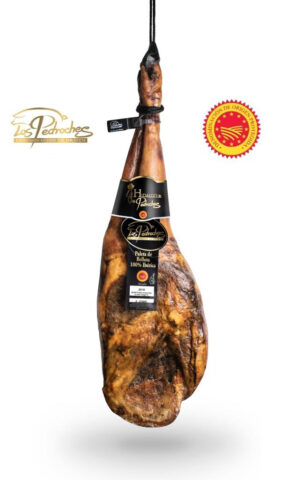
Products protected by a PDO may use their own seals provided they respect the colours, mentions and other requirements of the Iberian standard when using these sales designations. A PDO adds its own territorial and production specification; it does not erase the regulatory meaning of black, red, green or white.
Five common buying mistakes
- Judging by hoof colour. The hoof is not a substitute for the official seal and sales designation.
- Calling every Iberian ham “pata negra”. The expression is reserved for acorn-fed 100% Iberian.
- Assuming red means grain-fed. Red is an acorn-fed Iberian category.
- Assuming green can never be 100% Iberian. Feeding/management and breed percentage are separate variables.
- Comparing price without comparing categories. Breed, feeding, weight, curing, PDO status, format and producer can all affect price.
Using the seal to make a better choice
Use the seal as the beginning of the decision rather than the whole decision. First decide how you intend to consume the product: a whole piece for regular use, a smaller shoulder, pre-sliced packs or a gift. Then compare within equivalent categories. If you are still deciding between the two cuts, our guide to Iberian ham versus shoulder explains yield, anatomy and consumption rate.
You can compare formats and designations in our ham and shoulder selection, with the producer and product information visible before purchase.
Sources and regulation
The main reference is Spain's Royal Decree 4/2014 on the Iberian Quality Standard. In July 2026 the Spanish Ministry of Agriculture announced ongoing work with the sector to update the standard; this is a review process, not a replacement standard already in force. The Ministry's July 2026 update explains that work.
Related products
-
EMDO Selection SaleSale!
 Select options
This product has multiple variants. The options may be chosen on the product page
Select options
This product has multiple variants. The options may be chosen on the product page
-
EMDO Selection SaleSale!Select options
This product has multiple variants. The options may be chosen on the product page
-
EMDO Selection SaleSale!Select options
This product has multiple variants. The options may be chosen on the product page
-
EMDO Selection SaleSale!Select options
This product has multiple variants. The options may be chosen on the product page
-
Sale!Select options
This product has multiple variants. The options may be chosen on the product page