
Leave sliced Iberian ham at room temperature for a few minutes and small shiny droplets may appear on the surface. People often say the ham is “sweating”. The expression is vivid, but the mechanism matters: in most normal cases these droplets are not water and are not evidence that the ham has spoiled; they are fat softening and becoming visible at the surface.
Temperature changes the texture of ham fat dramatically. A slice that is very cold can look firm, matte and relatively restrained in aroma. As it warms, it becomes more flexible, glossy and aromatic.
Ham does not literally sweat
“Sweating” is a colloquial term. Cured ham is not producing water through a physiological process. What you normally see is part of the fat phase losing firmness as temperature rises and moving towards the surface of a slice or cut face.
This can be especially noticeable in well-marbled Iberian ham, where intramuscular fat is distributed between muscle fibres and responds quickly when a thin slice is no longer cold.
Why fat changes so much with temperature
Ham fat is a complex mixture of fatty acids. It does not have one single temperature at which all fat suddenly changes from solid to liquid. Different fractions soften progressively.
As temperature rises, the fat loses structure. Thin slices respond quickly because they have a large exposed surface relative to their mass. The result is the characteristic sheen and, sometimes, tiny oily beads.
Is it a sign of quality?
Melting, glossy fat can be completely normal and is part of the sensory experience of Iberian ham. However, it should not be used as a stand-alone proof of quality. A ham is not automatically better because it “sweats” more.
Fat composition, the anatomical section, slice thickness, starting temperature, room temperature and serving time all affect what you see. Even two slices from the same ham can behave differently.
The section of the ham matters
The maza, contramaza, punta and other areas do not have identical fat distribution or muscle structure. A slice from a more heavily infiltrated section can appear glossier and feel more unctuous than a leaner slice.
That is one reason visual comparisons between random slices can be misleading.
Why cold ham smells less aromatic
Temperature affects not only fat texture but also the volatility of aroma compounds. When a slice is too cold, the fat stays firmer and aromatic expression can seem reduced.
As it warms, the fat becomes more yielding and the aroma opens up. Serving ham straight from a very cold environment can therefore hide part of its sensory potential.
Tempering is not the same as heating
Do not place ham next to a heater, in direct sunlight or on a warm surface to force the fat to melt. The aim is simply to let it reach a pleasant serving temperature gradually.
Excess heat can make too much fat liquefy, leave the slice greasy and damage its structure. Keeping food for unnecessarily long periods in unsuitable conditions is also poor practice.
How to distinguish fat from condensation
Fat feels oily and remains as a greasy film. Condensation is water that forms when a cold surface meets warmer humid air. That moisture can appear on packaging, a plate or the product surface after refrigeration.
With vacuum-packed ham, both processes can happen at the same time: fat softens while condensation forms outside or around a very cold pack. Allowing the sealed pack to temper before opening helps reduce moisture condensing directly on the slices.
What about liquid inside a vacuum pack?
A small amount of exudate inside packaging is not necessarily the same thing as oily “sweating” on a tempered slice. Moisture, natural juices and fat can coexist inside a pack. Assess the product as a whole, including vacuum integrity, storage history and the producer's date guidance.
A swollen pack, abnormal loss of vacuum, persistent unpleasant smell or other clear spoilage signs cannot simply be explained away as normal fat.
Gloss does not replace smell and texture
A shiny slice can be perfectly normal; a matte slice is not automatically bad. Condition is assessed using aroma, texture, colour, fat appearance and storage history together.
If the concern is an unusual odour, see our guide to distinguishing rancidity from normal cured-ham aromas. That is a different diagnostic question.
Yellow fat is a different issue too
Fat colour and fat melting are separate characteristics. Fat can look more yellow for several reasons while still softening normally as it warms. Surface shine cannot diagnose the colour or condition of deeper fat.
Our guide to yellow fat on Iberian ham deals with that visual sign specifically.
Before serving vacuum-sliced ham
Follow the producer's storage instructions and allow overly cold slices to lose some chill before eating. A useful visual cue is that the slices separate more easily and the fat becomes slightly translucent and glossy.
Our guide to serving Iberian ham covers temperature, slice thickness, plating and timing in more detail.
What happens on a whole ham?
An opened ham can also develop a glossy cut face in a warm room. There is no need to interpret every oily bead as a defect. Protect the cut surface appropriately and avoid direct sun, excessive heat and extreme temperature changes.
Before opening a piece, our guide to storing a whole ham or shoulder explains the conditions that favour stable storage.
Does more “sweating” prove acorn feeding?
No. Surface fat behaviour cannot by itself prove feeding regime, breed percentage or commercial category. It is a mistake to turn a temperature-dependent visual characteristic into an authenticity test.
Iberian classification is verified through labels, seals and product documentation, not by counting oily droplets on a plate.
When should you be concerned?
Normal oily gloss after tempering is one thing. Persistent unpleasant odours, abnormal slime, unexpected mould on the edible surface, widespread alteration or a questionable storage history are different signs.
If several spoilage indicators appear together, do not dismiss them as “just the fat”.
The short explanation
- Clear oily beads as ham warms: usually softening fat.
- Very cold ham: firmer fat, less shine and quieter aroma.
- Excess heat: can melt too much fat and worsen presentation.
- Water after refrigeration: may be condensation rather than fat.
- Bad smell, slime or other abnormal signs: require a separate assessment.
“Sweating” is mostly fat physics
As a good slice of ham loses its chill, the fat becomes softer, glossier and more aromatic. That is one reason serving temperature matters. Understanding the effect prevents two opposite mistakes: assuming every droplet means spoilage, or treating every shiny slice as automatic proof of exceptional quality.
Iberian hams and shoulders
-
Sale!
 Select options
This product has multiple variants. The options may be chosen on the product page
Select options
This product has multiple variants. The options may be chosen on the product page
-
Sale!Select options
This product has multiple variants. The options may be chosen on the product page
-
EMDO Selection SaleSale!Select options
This product has multiple variants. The options may be chosen on the product page
-
EMDO Selection SaleSale!Select options
This product has multiple variants. The options may be chosen on the product page
-

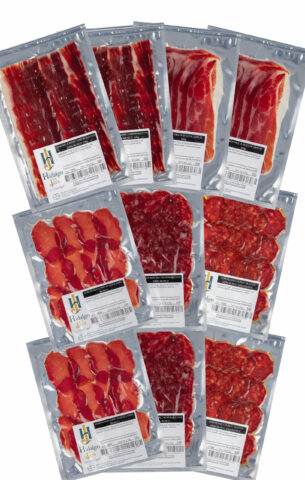

 Tasting pack of 100% Iberian acorn (2x ham, 2x shoulder ham, 2x cured loin, 2x salchichón, 2x chorizo)