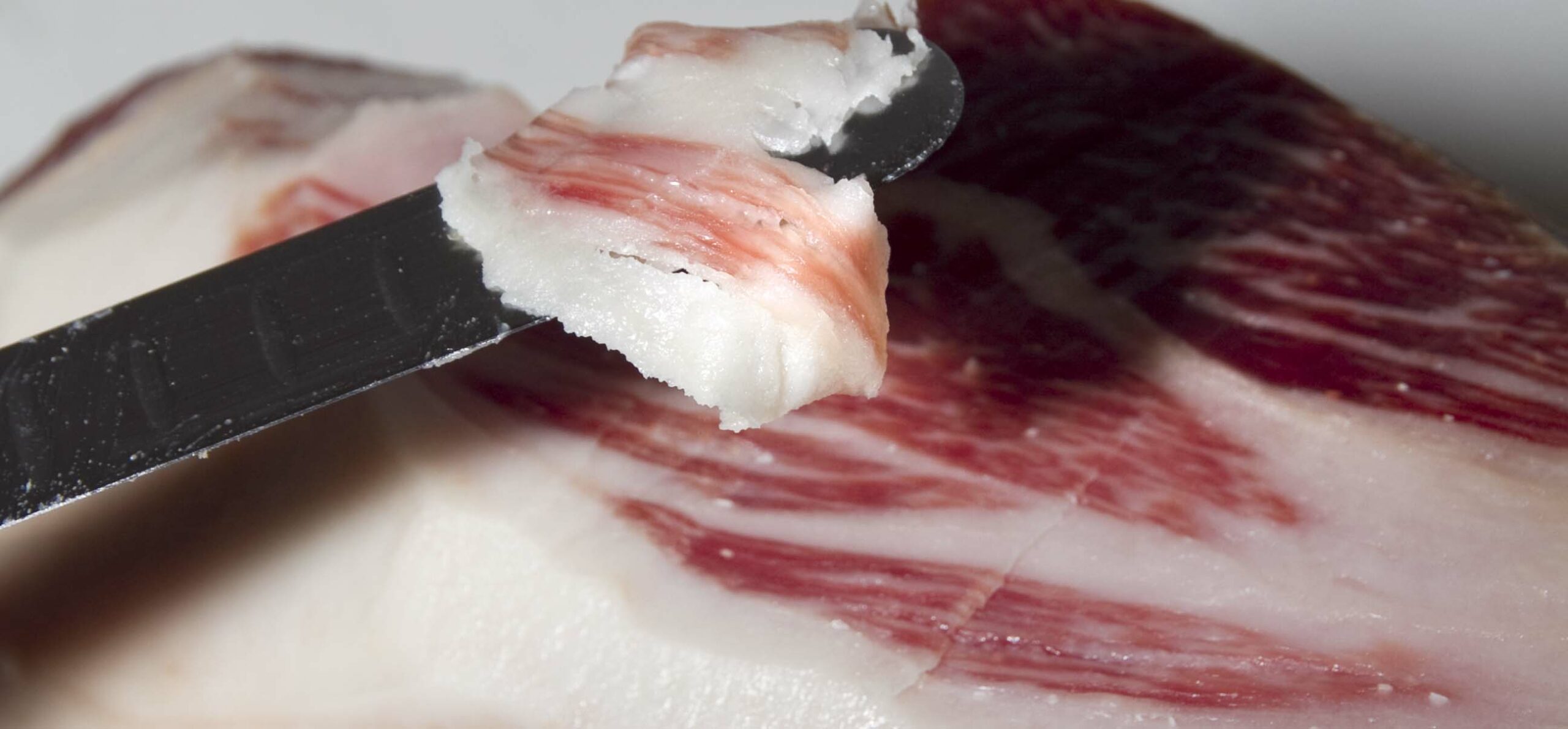
When carving Iberian ham, it is quite common to find small hard white specks embedded in the lean meat. They may initially look like grains of salt, fat spots or even something related to mould. When the specks are dry, firm and located inside the meat, however, a common explanation is the formation of tyrosine crystals during curing.
Tyrosine is an amino acid found in proteins. As ham matures, naturally occurring enzymes break large proteins into smaller fragments and release free amino acids. Under certain conditions of concentration, moisture, temperature and time, some compounds can precipitate and become visible as crystals. This phenomenon has been studied in dry-cured ham and should not automatically be interpreted as spoilage.
What are the white crystals in cured ham?
Tyrosine-related crystals usually appear as white or off-white dots, sometimes matte and sometimes slightly shiny. They can be tiny or large enough to create a brief crunchy sensation when chewed. They are found within muscle tissue or on the face of a freshly cut slice because carving exposes the inside of the ham.
They do not grow as a film over the product and they are not fluffy, hairy or wet. Location and texture are therefore two of the easiest ways to distinguish a hard crystal from superficial fungal growth.
Why does tyrosine crystallise during curing?
A ham is not chemically static while it dries. Proteolysis and lipolysis take place for months and are part of the development of flavour, aroma and texture. During proteolysis, long protein chains are progressively broken down and the level of free amino acids rises. Tyrosine can reach a concentration at which it precipitates because its solubility is limited under certain conditions.
This is why crystals are often associated with products that have had time to mature. But one popular claim needs qualification: tyrosine alone does not prove that a ham is acorn-fed, 100% Iberian, PDO-certified or automatically superior. Crystal formation also depends on processing conditions, salting, drying temperature, water loss, pH and the individual ham.
Are white tyrosine crystals safe to eat?
When they are crystals embedded in the lean part of a properly cured and stored ham, yes. They are part of the food and do not need to be removed. Larger crystals can feel slightly crunchy, but they should not create an unpleasant off-flavour. They are not parasites or eggs and do not by themselves indicate spoilage.
The answer changes when the white material does not fit that description. A wet or slimy layer, filamentous growth, a clearly putrid smell, a swollen package or loss of vacuum in sliced ham should be treated as possible deterioration rather than dismissed as “tyrosine”.
How to tell tyrosine, fat, salt and mould apart
Tyrosine: small, dry, hard, well-defined specks in the lean meat. They do not spread like a coating and cannot simply be wiped from the surface.
Fat: usually forms streaks, flecks or larger white areas and is much softer. Iberian pork fat becomes increasingly supple at room temperature and may look glossy or translucent. It does not have the chalky hardness of a crystal.
Salt: may be visible on the exterior of some cured products, but the classic hard dots inside a slice should not automatically be described as salt without considering their position and texture.
Mould: on a whole ham can develop on the rind or external fat as a surface film or colony. It is a different situation covered in our guide to mould on Iberian ham.
Are all white spots necessarily tyrosine?
“White spot” is a visual description, not a laboratory diagnosis. Researchers have described amino-acid precipitates and other white deposits in dry-cured ham. Tyrosine is the best-known explanation, but it is sensible not to identify every white mark from colour alone.
If the mark looks unlike a dry crystal or the ham has other abnormal changes, contact the producer. Batch information and clear photographs are more useful than trying to diagnose a quality problem solely from a white colour.
Do more crystals mean better ham?
No. Their presence is consistent with biochemical changes that occur during maturation, but there is no reliable “more white crystals equals better ham” rule. Iberian ham quality depends on many factors: raw material, breed percentage where relevant, feeding and husbandry, salting, drying, cellar maturation, fat balance, aroma, texture and the absence of defects.
Two excellent hams can contain very different numbers of crystals. A visible speck also cannot turn an ordinary piece into a premium one. Tyrosine is better understood as a possible outcome of curing rather than a stand-alone quality certificate.
Why are the crystals more visible in some slices?
Contrast matters. A white dot stands out strongly against dark red lean meat. Slice thickness and the part of the ham being carved also affect visibility. Different areas have different proportions of moisture, fat and muscle, so the crystals do not need to be distributed evenly.
In very thin slices they may look like tiny chalky specks. In a thicker slice one may occasionally be felt when chewing. Neither is a concern when the rest of the ham looks, smells and has been stored normally.
What if white dots appear in a vacuum pack?
First check whether the dots are inside the slices and look like hard crystals. If so, they do not mean the vacuum has failed. Let the pack come to serving temperature as recommended by the producer and observe the normal changes in fat and texture.
If the package is swollen, leaking, has lost its seal, contains abnormal liquid, develops visible growth or has a persistent off-odour, do not eat it simply because some white dots also look like crystals. Keep the packaging and contact the seller.
Frequently asked questions
Are the white dots in ham salt?
Hard specks within the lean meat are commonly associated with precipitated amino acids such as tyrosine rather than ordinary grains of salt.
Does tyrosine change the flavour?
It normally does not dominate flavour. A larger crystal may produce a brief crunch, while the ham's flavour comes from the overall curing process.
Should I remove the crystals?
There is no need when they are part of a sound cured ham. You can remove a particular speck for personal preference, but identified tyrosine is not a reason to discard the slice.
Is tyrosine the same as marbled fat?
No. Intramuscular fat forms soft, melting streaks between muscle fibres; tyrosine appears as small hard crystals. Both can occur in the same slice for entirely different reasons.
To compare whole pieces and sliced formats, browse our hams and shoulders.
-
-
EMDO Selection
-

 Canela Beans
  Pedrosillano Chickpeas