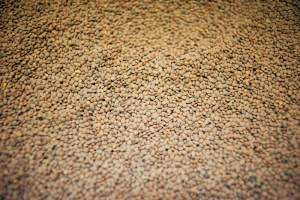
If the question is which legume has the most protein, the answer changes substantially depending on whether soy is included. Among legumes commonly known and eaten in Spain, dry soybeans lead by a clear margin. Among more traditional pulse dishes, lentils and dried broad beans are the strongest performers.
To make the comparison valid, all figures below refer to 100 g of dry product from the same reference source. Mixing a dry value with a cooked value would produce a misleading ranking.
Ranking: protein in legumes per 100 g
| Rank | Dry legume | Protein per 100 g |
|---|---|---|
| 1 | Soybeans | 35.9 g |
| 2 | Lentils | 23.8 g |
| 3 | Dried broad beans | 23.0 g |
| 4 | Dried peas | 21.6 g |
| 5 | Chickpeas | 19.4 g |
| 6 | Dry beans | 19.0 g |
Approximate values per 100 g dry product from composition tables compiled by the Spanish Nutrition Foundation.
Soy is the highest-protein legume in this comparison
At around 35.9 g of protein per 100 g dry weight, soy is well ahead of the others. Its wider composition is also different: it contains considerably more fat and fewer carbohydrates than traditional dry pulses.
So while soy is botanically a legume and belongs in the comparison, it should not be treated as nutritionally identical to a chickpea or lentil.
What about lentils, chickpeas and beans?
If we focus on three of the legumes most familiar in Spanish homes, the dry-weight ranking is:
- Lentils: 23.8 g/100 g.
- Chickpeas: 19.4 g/100 g.
- Dry beans: 19.0 g/100 g.
The difference between chickpeas and beans is small in this reference table, while lentils are somewhat higher. For the broader picture, see our chickpea, lentil and bean comparison.
Why cooked legumes show less protein per 100 g
This is one of the most common sources of confusion. Dry lentils can show more than 20 g of protein per 100 g, while a cooked-lentil table will show much less. Water is the main reason.
As legumes soak and cook, they absorb water and become much heavier. The protein is distributed through a larger weight of food. The lower concentration does not mean cooking has removed most of the protein.
How much protein is in a serving?
For a specific dish, do not simply apply dry-food values to the cooked weight. Either use the amount of dry legume that went into the recipe or use a nutrition table specifically for the cooked food.
A legume dish may also contain vegetables, grain, meat, fish, egg or other ingredients, so total protein is the sum of the whole meal.
Is legume protein the same as animal protein?
Legume proteins provide essential amino acids, but their amino-acid profile is not identical to that of animal foods. FEN describes their protein quality as good overall while noting that some sulphur-containing amino acids tend to be more limited.
Cereals have a complementary profile. This helps explain the nutritional logic of traditional combinations such as legumes with rice. A varied diet does not require every complementary protein to be eaten in the same mouthful.
Does more protein make one legume better?
No. Protein is only one part of nutritional value. A legume with slightly less protein may provide more fibre or have a different mineral profile. Dry beans, for example, sit below lentils for protein in this table but lead our fibre comparison.
How to read a protein comparison correctly
- Check whether the figures refer to dry or cooked food.
- Compare the same quantity, such as 100 g against 100 g.
- Use the same composition database where possible.
- Do not confuse protein per 100 g with protein per normal serving.
- Remember that variety, origin and moisture can cause small differences.
Conclusion: which legume has the most protein?
Dry soybeans contain the most protein in this comparison, at 35.9 g per 100 g. Among more traditional Spanish pulses, lentils stand out at 23.8 g, followed by dried broad beans and dried peas.
Chickpeas and beans are also valuable plant-protein foods. The best choice depends on the full nutrient profile and how the food fits into a meal, not simply on first place in one ranking.
Frequently asked questions
Which has more protein, lentils or chickpeas?
In the dry values used here, lentils provide 23.8 g per 100 g and chickpeas 19.4 g.
Which has more protein, lentils or beans?
Lentils are higher in this table: 23.8 g versus 19.0 g per 100 g dry product.
Is soy a legume?
Yes. It is a legume, although its composition differs substantially from chickpeas, lentils and beans, particularly because it contains more protein and fat.
Sources
Comparison based on the Spanish Nutrition Foundation (FEN) report on legumes, nutrition and health. You can also read our broader guide to the nutrients found in legumes.