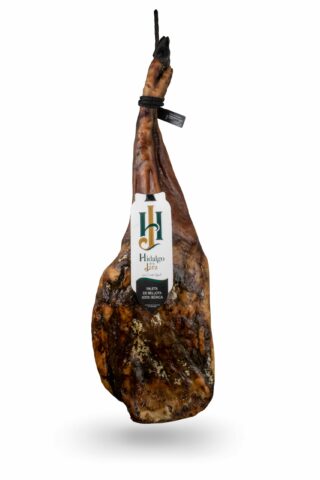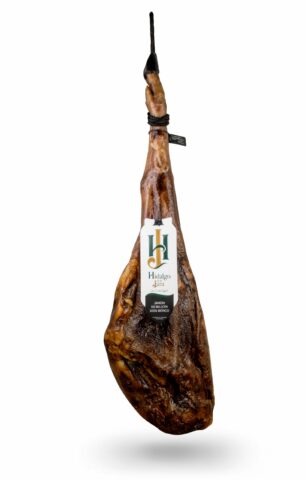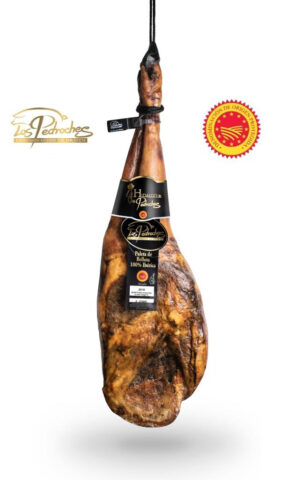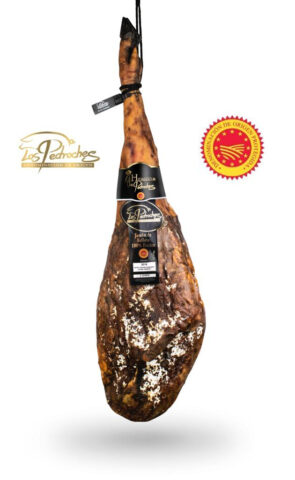
Choosing between Iberian ham and Iberian shoulder is not a matter of deciding which one is inherently “better”. Both can come from pigs with the same breed percentage and feeding category and both can be cured with the same care. What changes is the anatomy, and that affects size, bone-to-meat ratio, carving and the way the product eats. The right choice depends mainly on how many people will eat it, how quickly, your budget and the style of flavour you enjoy.
The essential distinction is simple: ham comes from the pig's hind leg, while paleta comes from the front shoulder. From that anatomical difference come most of the practical differences. A shoulder is not simply a small ham and it is certainly not an inferior grade by definition.
The anatomical difference explains most of the buying decision
The hind leg has larger muscles and a longer shape. A whole ham normally offers a broad maza and large cutting surfaces where long, thin slices can be produced relatively easily once the piece is correctly positioned.
The shoulder includes the scapula and has a more compact, irregular structure. There is more bone relative to total weight and the carver encounters changes of angle sooner. For someone learning to carve at home, that geometry can make the shoulder feel less straightforward to use efficiently.
Size matters because it determines how long the piece stays open
A whole ham is usually substantially heavier than a shoulder. That is useful for a family, regular ham eaters or periods with frequent guests. If consumption is occasional, however, a large piece may remain open for longer than ideal and requires more attention to carving and storage.
A shoulder often suits smaller households that still want the ritual of carving a whole piece. There is no universal number of days in which it must be finished; room conditions, frequency of use and the individual piece all matter. The practical question is whether the size matches your real consumption rate.
Yield: do not compare purchase price alone
A shoulder generally has a higher proportion of bone and more areas that are awkward to carve. As a result, a lower price for the whole piece does not translate directly into the same difference in cost per kilogram of edible slices.
A ham tends to provide a higher percentage yield and larger slicing surfaces. The shoulder costs less in absolute terms but usually produces a lower proportion of clean slices. That is not a disadvantage if its smaller size prevents waste; it simply means that entry price and edible yield are different measurements.
If you want to understand how much sliced product a piece may produce, our guide to how many packs come from an Iberian ham explains why yield varies from one piece to another.
Does Iberian shoulder taste different?
It can. The shoulder combines smaller muscles, fat and connective tissue in a compact structure. Many enthusiasts perceive it as intense, juicy and highly expressive. A ham, meanwhile, offers a long journey through maza, babilla, punta and hock, with noticeable changes in fat, texture and flavour.
Those descriptions are tendencies, not guarantees. Breed, feeding, curing, salt balance and the individual piece matter enormously. A superb shoulder can be more complex than an average ham. Compare products within equivalent categories rather than assuming the name of the cut determines quality.
Acorn-fed, field-feed, feed and Iberian percentage apply to both
It is a mistake to associate “ham” automatically with a higher category and “shoulder” with a lower one. Both hams and shoulders can be sold under the applicable Iberian quality categories. The full commercial designation provides the relevant information about production/feeding category and breed percentage.
Before comparing prices, therefore, make sure you are comparing like with like. Our guide to what 100% Iberian acorn-fed ham really means separates breed from feeding category.
Which is easier to carve at home?
In general, a ham gives beginners larger, flatter areas on which to maintain a long, even cut. A shoulder forces the knife to adapt to bones and changing planes sooner. A beginner who treats a shoulder exactly like a ham may leave more edible meat around the bones.
That is a reason to learn the anatomy, not to avoid the shoulder. Appropriate knives and controlled strokes matter. Less attractive trimmings are still excellent for cooking and properly prepared bones can be used too.
For one or two people, shoulder has a practical advantage
Consider a household of one or two people that eats a few slices several times a week. A shoulder provides the experience of owning and carving a complete Iberian piece without committing to the volume of a large ham. The initial purchase is also generally lower when comparing equivalent categories.
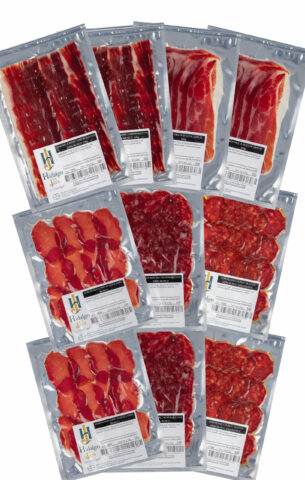
If you eat Iberian ham only occasionally, sliced vacuum packs may be more logical still. That becomes a different question — whole piece versus sliced packs — rather than a direct ham-versus-shoulder comparison.
For families and frequent consumption, ham becomes attractive
When several people eat it regularly, the larger size is no longer a drawback. Better relative yield, broad cutting surfaces and the number of portions available make ham convenient for busy households and periods with frequent entertaining.
It also lets you experience clearer differences between the anatomical sections of the piece, from the broad maza to the leaner babilla and the intensely flavoured hock.
What about budget?
Within the same category, shoulder usually requires a smaller total outlay because the piece weighs less. That can allow a buyer to move into a higher product category without paying the price of an entire ham. Ham, however, normally provides more edible product relative to its total weight.
There is therefore no single answer to “which is cheaper?”. For purchase price per piece, shoulder usually wins. For edible yield, the gap narrows. And if a large ham dries out because it is eaten too slowly, theoretical yield is irrelevant.
A simple decision rule
- Choose shoulder for a smaller household, quicker turnover, a lower initial spend or a compact, intense style.
- Choose ham for frequent consumption, several diners, better relative yield and larger carving surfaces.
- Choose sliced packs for occasional consumption or when you do not want to manage a whole piece.
Choose the quality category separately. First decide which physical format fits your household; then compare acorn feeding, breed percentage, origin and producer.
Frequently asked questions
Is Iberian shoulder lower quality than Iberian ham?
No. They are different limbs. Quality depends on the raw material, category, processing and curing rather than simply whether the cut is from the front or rear leg.
Does shoulder taste stronger?
It is often perceived as more intense because of its anatomy and fat distribution, but the actual profile varies by piece and producer.
Which has more bone?
The shoulder generally contains more bone relative to total weight, so its percentage yield is usually lower.
Which is better as a gift?
Think about the recipient's household. A shoulder can be easier for one or two people to finish; a ham can suit a family that eats Iberian cured meat frequently.
Browse the current ham and shoulder formats available from producers at El Mercado de Origen.
-
EMDO Selection SaleSale!
 Select options
This product has multiple variants. The options may be chosen on the product page
Select options
This product has multiple variants. The options may be chosen on the product page
-
EMDO Selection SaleSale!Select options
This product has multiple variants. The options may be chosen on the product page
-
EMDO Selection SaleSale!Select options
This product has multiple variants. The options may be chosen on the product page
-
EMDO Selection SaleSale!Select options
This product has multiple variants. The options may be chosen on the product page
-
Last units availableSaleSale!Select options
This product has multiple variants. The options may be chosen on the product page