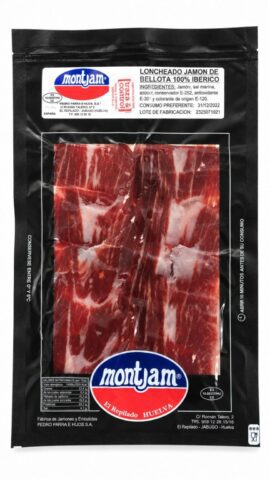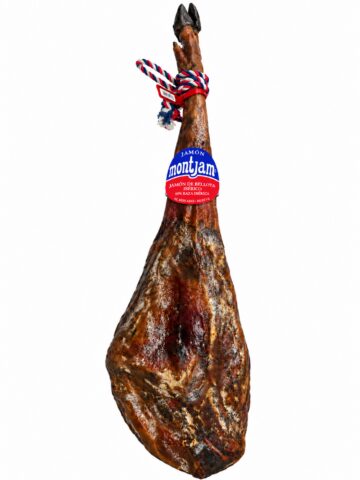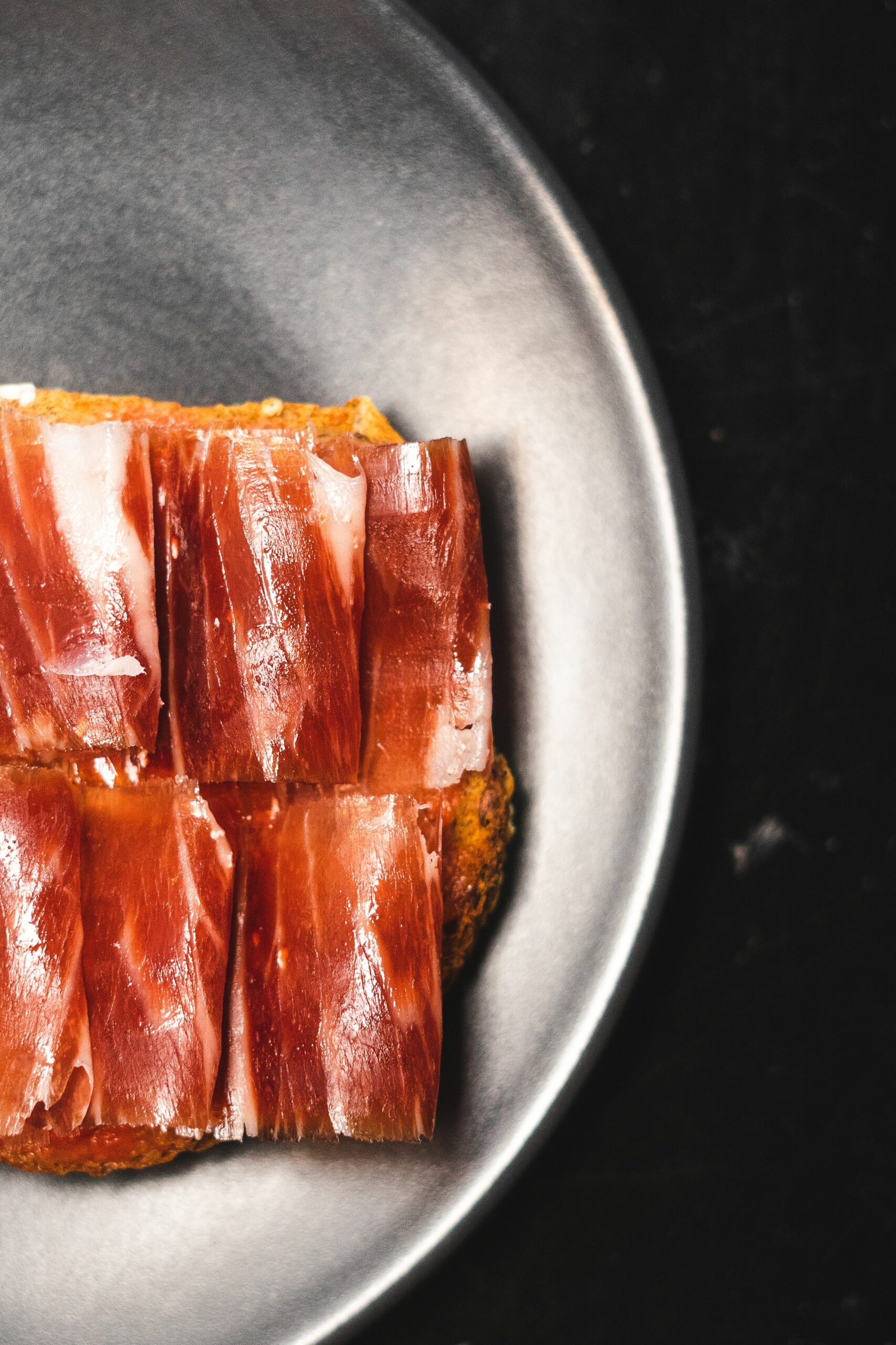
One of the most recognisable features of a slice of Iberian ham is the contrast between deep red lean meat and white streaks of intramuscular fat. The fat is not confined to the outer edge of the leg: some is distributed between muscle fibres and, when sliced thinly and served at the right temperature, it becomes glossy, supple and remarkably soft.
Marbling helps explain why Iberian ham can remain juicy and persistent in the mouth after a long curing period. However, another simplification should be avoided: more visible fat does not automatically mean higher quality. Marbling is only one part of a much bigger picture involving genetics, feeding, husbandry, curing, salt balance, aroma, texture and freedom from defects.
What is intramuscular fat?
Intramuscular fat is deposited within the muscle, between fibres and bundles of muscle tissue. It appears as fine white lines, branching streaks or small pale areas through the lean meat. It is different from the subcutaneous fat covering the outside of the leg and from larger fat deposits in particular anatomical areas.
In a very thin slice, this fat can be spread across much of the surface. At room temperature it softens readily, helping the slice feel supple rather than dry or rigid.
Why does the Iberian pig develop marbling?
Iberian pig genetics are associated with a strong capacity to deposit intramuscular fat compared with many pig types selected mainly for lean growth. This genetic predisposition interacts with age, exercise, feeding, body weight and the finishing phase.
There is therefore no single cause. A pig does not develop marbling simply because it eats acorns, and visible marbling cannot by itself tell you the feeding system. Breed and the animal's metabolism are central parts of the explanation.
What role does feeding play?
Feeding influences both the amount and the composition of fat. In acorn-finished systems, the montanera diet provides large amounts of oleic acid from acorns while the pigs are also active in the dehesa. This contributes to the characteristic lipid profile of many acorn-fed hams.
But you cannot reconstruct an animal's diet accurately by looking at a slice. To establish whether a ham is bellota, cebo de campo or cebo, use the label, official seal and commercial designation, not the degree of marbling alone.
How does marbling affect texture?
Ham loses a great deal of water during curing. Completely lean cured muscle would feel considerably firmer. Fat between muscle fibres provides lubrication and softness, so a thin slice can feel more tender and unctuous when chewed.
Serving temperature matters. Straight from a cold environment, the fat is firmer and more opaque. As it warms, it becomes flexible and translucent. This is why vacuum-packed sliced ham generally shows its texture better after the tempering time recommended by the producer.
How does fat affect aroma and flavour?
Fat carries many aroma compounds. Lipid transformations during maturation contribute to the complex profile of cured ham. As the fat softens in the mouth, it helps release and prolong aromatic sensations.
That does not mean every fatty flavour is desirable. Excessive oxidation can produce rancid notes, and an unbalanced ham can feel heavy. Sensory quality comes from balance between lean meat, fat, salt, curing and aroma.
Is every white mark intramuscular fat?
No. A slice may contain fat streaks, soft fat deposits and also white tyrosine crystals. The simplest distinction is texture: fat softens and may melt; a tyrosine crystal is small and hard.
Pale areas of connective tissue can also appear. Ham anatomy is complex, and not every white feature has the same origin.
Does more marbling mean better ham?
Not necessarily. Attractive marbling often contributes to pleasant texture, but final quality requires much more. An excessively fatty piece may provide less lean yield than expected, and abundant fat cannot correct problems in salting, curing, oxidation or aroma.
Assessment should be holistic. A good slice balances enough fat for juiciness and persistence with sound lean texture, clean aromas and proper curing.
Can marbling tell you whether a ham is 100% Iberian?
No. Breed percentage is established by regulated product information. Genetics influence the capacity to deposit fat, but a photograph cannot reliably distinguish a 50%, 75% or 100% Iberian ham.
Read our guide to what 50%, 75% and 100% Iberian mean for the labelling distinction.
Can you identify acorn-fed ham from the fat?
No. Acorn feeding can influence fat composition, but the commercial category should not be diagnosed visually. The seal colour, sales designation and label provide the relevant regulated information.
A heavily marbled slice can look appealing, but appearance is not a substitute for traceability.
Why does the fat look almost liquid?
Iberian pork fat contains a high proportion of unsaturated fatty acids, including substantial oleic acid in many products, and can have a relatively low melting point. As a thin slice warms, the surface becomes glossy and the fat deforms easily.
This shine does not usually mean the ham is releasing water. It is normally softened fat, which is why a plate of ham often looks more lustrous after a few minutes at serving temperature.
What else should you check when buying?
- Sales designation: breed and feeding category should be stated correctly.
- Seal and label: these establish the regulated category.
- Producer and traceability: useful for understanding origin and process.
- Format: whole leg, boneless and sliced options have different yields and storage needs.
- Curing: final balance matters more than a single number of months.
- How you will eat it: a whole ham makes sense only when it can be consumed at a suitable pace.
Frequently asked questions
Is a lot of white fat bad?
Not by itself. Fat is an essential part of Iberian ham, although there should be a sensible balance between external cover, marbling and lean yield.
Do you eat intramuscular fat?
Yes. In a properly sliced ham it is part of the sensory experience and contributes to texture and aroma.
Should the white streaks be removed?
No. External oxidised fat or rind may be trimmed when preparing the carving area, but internal marbling is normally eaten with the lean meat.
Is intramuscular fat the same as marbling?
Yes in culinary language. “Marbling” describes the visible distribution of fat through muscle.
Compare pieces, feeding categories and formats in our hams and shoulders.
-
-
EMDO Selection
-