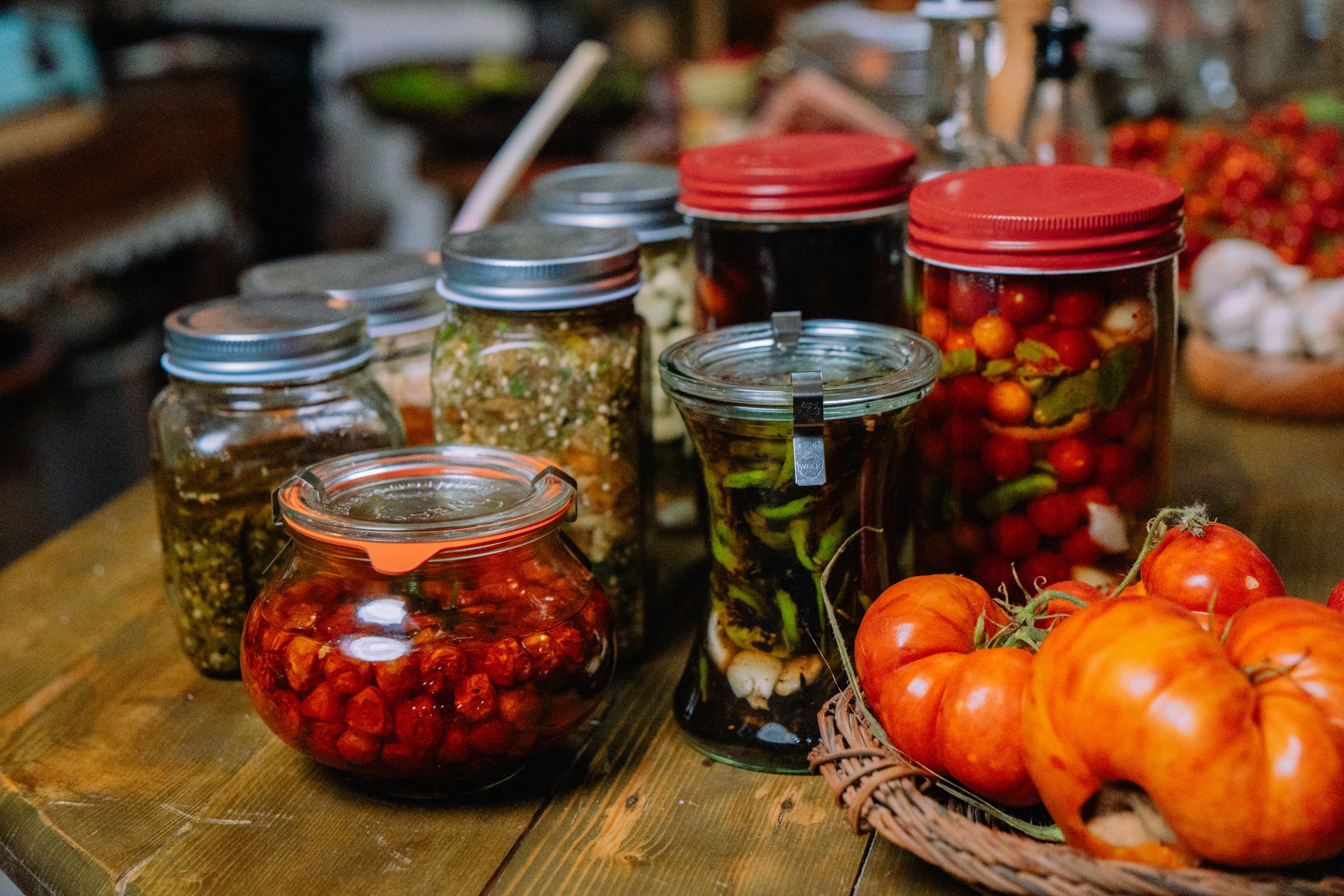
A vegetable preserve can remain in a pantry for months without refrigeration, yet once opened it usually needs to go into the refrigerator. The explanation is not simply the jar or can: it is the combination of formulation, heat processing, hermetic sealing and process control.
Understanding commercial preservation helps you interpret best-before information, recognise containers that should not be used and understand why an industrial preserve and a jar made at home cannot automatically be treated as equivalent.
Preserving food is more than putting it in a jar
Microorganisms need particular conditions to grow. Preservation changes those conditions or applies a process that keeps food stable for its intended life. In commercial canned foods, heat and container integrity are fundamental tools.
The food is placed in a package designed for the process, hermetically sealed and treated according to a schedule developed for that specific product. Time and temperature depend on composition, acidity, package size, product density and other factors.
What does commercial sterility mean?
Food technology uses the term commercial sterility. It does not literally mean that every possible microorganism in existence has been removed. It means that processing has made the food safe and stable under its normal intended storage conditions by controlling organisms capable of growing and causing spoilage or illness under those conditions.
Food-safety authorities such as the USDA describe thermally processed, commercially sterile foods as products in hermetically sealed containers designed to remain shelf stable before opening.
The role of the hermetic seal
Heat treatment would lose much of its value if microorganisms could simply enter afterwards. The package therefore has to maintain its integrity. Glass jars depend on the lid and seal; cans depend on intact seams; other packages use their own sealing systems.
A bulging container, leaking package, lost vacuum, seriously rusted can or cracked jar should be discarded. Do not taste a suspicious preserve “just to check”.
Sterilisation and pasteurisation are not the same
Pasteurisation uses heat to reduce microorganisms and extend shelf life, but some pasteurised products still require refrigeration. Commercial sterilisation for a shelf-stable preserve aims for a level of control that permits room-temperature storage while the package remains intact.
You cannot always identify the process just by looking at a jar. Acid foods, pickles, semi-preserves and refrigerated products can use different technologies. The label and producer's instructions remain the practical reference for consumers.
Acidity changes the required process
An acidic food and a low-acid food do not present identical microbiological risks. Acidity restricts the growth of certain organisms and changes the thermal process required. Acidified tomatoes, pickles and low-acid vegetables therefore need different approaches.
This is especially important in home canning. Copying an industrial time or improvising a process for low-acid food can be dangerous. Home preservation requires validated procedures and is outside the purpose of this article.
Why can a closed preserve stay outside the refrigerator?
When a product has been formulated, processed and sealed to be shelf stable, the closed package protects it from recontamination. That stability is what allows commercial distribution and pantry storage.
“Shelf stable” still does not mean indestructible. Excess heat accelerates quality changes, impact can damage seals, corrosion can compromise cans and time gradually changes colour, texture and flavour.
What changes when the jar is opened?
Opening breaks the hermetic barrier. Air enters, utensils contact the food and microorganisms from the environment again gain access. The product is no longer a sealed commercial preserve and must be handled according to the manufacturer's refrigeration and consumption instructions.
Clean utensils, prompt refrigeration and good closure help protect the remaining food. Follow any instruction to transfer leftovers to another container.
Does the date mean the food becomes dangerous the next day?
European labelling distinguishes use-by dates from best-before dates. Many shelf-stable preserves carry a best-before date linked to the period in which the maker guarantees expected quality when the product is stored correctly.
That never means package condition can be ignored. A preserve within date but with a bulging lid, leak or compromised seal should still be discarded.
Why heat changes texture and colour
The heat that creates stability also changes food. It can soften plant cell walls, alter pigments and transform aromas. Manufacturers balance time, temperature, cut size and covering liquid to achieve safety while protecting sensory quality.
A good preserve is therefore not trying to behave exactly like a raw vegetable. It has its own texture created by the preservation process and intended culinary use.
The covering liquid has a purpose too
Water, brine, oil, acidified solutions and other liquids can help transmit heat, protect texture, adjust flavour and form part of the formulation. They do not always need to be discarded automatically.
Some recipes can use part of the liquid in a sauce or dressing, while others benefit from draining. See our guide to cooking with vegetable preserves.
Commercial and home preserves are importantly different
Commercial processors work with defined schedules, temperature controls, equipment, seal verification, traceability and procedures designed for each food. Boiling a home jar for an arbitrary time does not reproduce those conditions.
Low-acid home canning in particular requires validated methods from competent food-safety authorities. This article explains the industrial principle behind products you buy; it is not a home-canning guide.
How to store an unopened preserve
A cool, dry pantry away from strong light and heat is suitable for products labelled as shelf stable. Avoid humid areas, positions above the oven and places under sinks where water and temperature changes are common.
Rotate stock by date and use older units first. Do not use jars or cans with serious damage around the closure, leaks, raised lids or other major abnormalities.
What to check before opening
Make sure the package is intact, with no leakage or swelling and a sound closure. When opening, pay attention to abnormal signs. Violent spurting without a product-specific explanation, clearly unpleasant odours or obvious spoilage are reasons to discard the food.
The useful principle is simple: a preserve is a system. Product, process and package work together. If that system loses integrity, appearance alone is not enough to guarantee safety.

 100% mature beef burgers – gluten-free (2)
  100% beef burgers – gluten-free (2)