“Let the meat rest before slicing” is one of the most repeated pieces of cooking advice. It is useful in many situations, but the popular explanation — “so all the juices go back to the centre” — is too simple. Meat coming off a pan or out of the oven contains temperature gradients, contracted muscle fibres, steam, melted fat and liquid under changing pressure. Resting allows that system to stabilise before slicing.
The result can be more even doneness and less liquid immediately flooding the cutting board. But the correct time depends on size, thickness, cooking method and target doneness. A thin steak and a large roast should not rest for the same period.
What happens inside meat during cooking?
Heat moves from the surface towards the centre. In a very hot pan, the outside may be far hotter than the core. Muscle proteins change structure and fibres contract. Some water moves within the tissue and some is lost through evaporation.
The larger the temperature difference between exterior and centre, the greater the thermal gradient. A thick piece continues receiving heat from its own hot outer layers after it has left the heat source.
This is carryover cooking
After a thick piece is removed, centre temperature can continue rising while the outside starts to cool. This is known as carryover cooking. The larger and hotter the piece, the more relevant it can become.
Resting should therefore be treated as part of the cooking process. If a roast is taken all the way to the desired final temperature before it leaves the oven, carryover can push it further than intended.
Do the juices really “redistribute”?
It is a convenient shorthand, but liquid does not simply travel from the centre to the outside and then neatly return. The real picture includes changing pressure, protein contraction, fat viscosity and falling temperature.
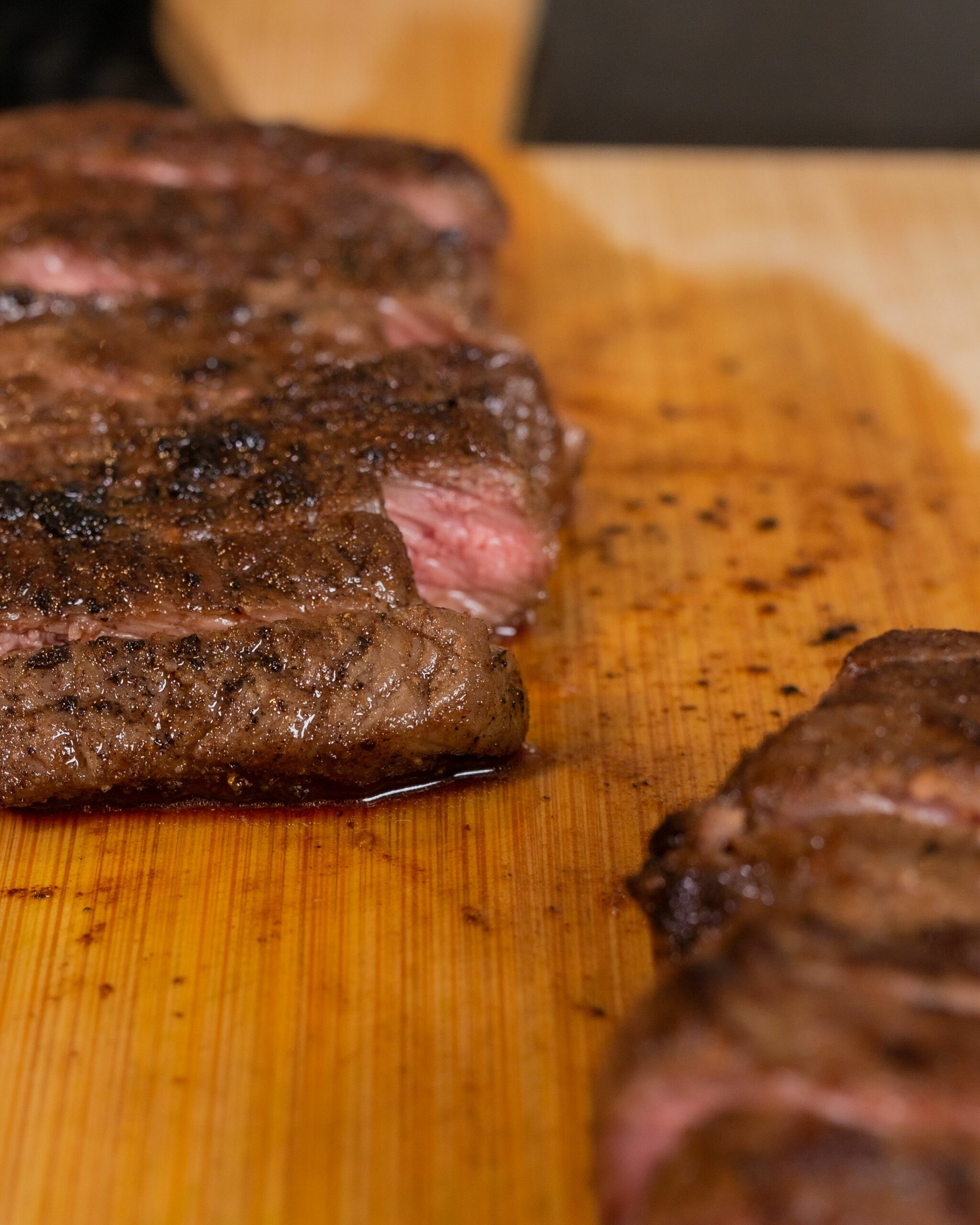
What we can observe is that cutting certain pieces immediately tends to release more liquid than waiting for a short rest. Resting reduces thermal and mechanical imbalance and can make slicing cleaner.
A wet cutting board does not automatically mean dry meat
The liquid released from beef is not blood; it is largely water mixed with proteins and pigments such as myoglobin. Seeing some liquid on the board does not prove that the steak has been ruined. Even well-rested beef can release juices.
Perceived juiciness also depends on intramuscular fat, doneness, muscle type, slice thickness and seasoning. Our guide to beef marbling explains another part of that sensation.
How long should an individual steak rest?
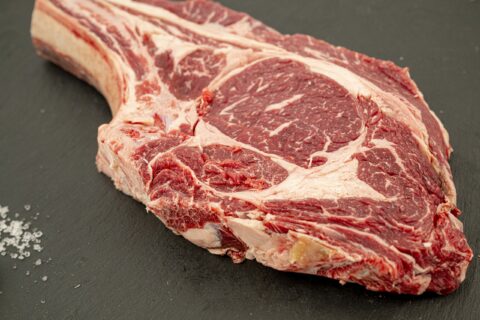
There is no universal number. A medium-thickness steak usually needs only a few minutes for the most dramatic gradients to settle without letting the surface become cold. A much thicker steak can benefit from longer.
Avoid rigid rules such as one minute per centimetre. A thin pan steak loses heat rapidly; a thick bone-in steak stores far more thermal energy.
Large roasts need a different approach
A large oven roast or roast beef can benefit from a substantially longer rest. It has more mass, a stronger temperature gradient and more carryover cooking. When it will be carved into many slices, stabilising the interior also makes the first and last portions more consistent.
Large roasts are often removed before they reach the desired final point and allowed to finish during rest. The exact rise depends on size, shape, cooking temperature and composition.
Should meat be covered while resting?
Loose covering can reduce heat loss, but sealing meat tightly traps steam and can soften a crisp crust. If you worked hard to create browning, avoid heavy condensation.
A loose sheet of foil can be useful for large pieces. Small steaks often need no covering at all.
The crust continues to change
The surface keeps evolving after the heat is switched off. Steam from inside migrates outward and can soften the crust. This is why some techniques use a final high-heat sear after a long gentle cook, although that is not necessary for an ordinary pan steak.
For large roasts, a rack can help prevent the underside from sitting in trapped moisture.
Resting cannot repair overcooking
If beef has already gone far beyond its desired point, resting cannot return lost water or reverse protein changes. Resting optimises the end of a well-controlled cook; it does not fix excessive heat.
The first decision remains choosing the right method for the muscle. See why some beef cuts need minutes and others need hours.
When resting matters less
Ground beef, thin strips, escalopes and very small pieces have smaller thermal gradients and cool quickly. A long rest can simply make them cold.
Technique must follow size. A thin burger does not need the same routine as a thick steak or a large roast.
Slicing after the rest still matters
Use a sharp knife and, where anatomy allows, slice across the main fibre direction to shorten fibres in each bite. This can dramatically improve perceived tenderness in long-fibred cuts.
A good rest followed by poor slicing can still produce a less pleasant texture.
Food safety and culinary resting are not identical
Culinary resting does not replace safe cooking and handling. Safety guidance differs for whole cuts and ground beef and should be followed independently. Some official safety systems also specify minimum rest periods in combination with particular temperatures.
“Resting for texture” and “resting as part of a safety time-temperature combination” are therefore related but distinct ideas.
A practical rule
The thicker and larger the piece, the more important it is to include resting in your doneness plan. The smaller and thinner it is, the shorter the rest. Use size, temperature and surface condition rather than one universal timer.
Good beef cookery is a sequence: choose the cut, use appropriate heat, remove it at the right moment, allow it to stabilise when useful, and slice in a way that respects the muscle structure.
Related beef products
-
Sale!
 Select options
This product has multiple variants. The options may be chosen on the product page
Select options
This product has multiple variants. The options may be chosen on the product page