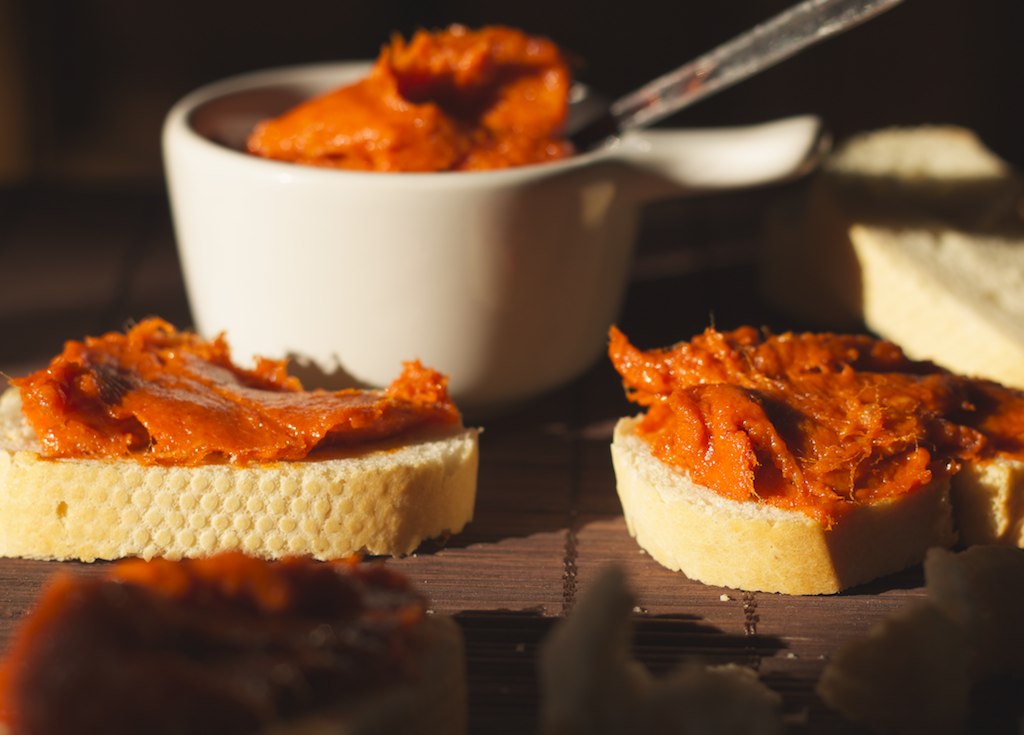
Sobrasada is a raw cured sausage made from pork meat and fat, salt, paprika and spices. Its most recognisable feature is its soft, spreadable texture, very different from the firmness of a dry chorizo or salchichón. When a product is described as Iberian sobrasada, its meat comes from Iberian pigs in the percentage declared by the producer.
It helps to separate several ideas. “Sobrasada” describes a type of product; “Iberian” refers to breed; and terms such as “acorn-fed” relate to feeding and production category where applicable. No single word replaces the complete information on the label.
Related cured-meat guides: how to store cured meats after openingwhen white mold on cured sausage is normalhow to freeze chorizo, salchichón and cured loin
What exactly is sobrasada?
Unlike coarse dry sausages that finish with a firm structure, sobrasada is designed to retain a creamy consistency. Meat and fat are seasoned primarily with paprika, which gives the characteristic red-orange colour, together with salt and other spices according to the recipe.
The mixture is stuffed into a casing and matured. The result is a cured product that, when labelled ready to eat, can be spread on bread after being brought to an appropriate serving temperature.
Is sobrasada a cured sausage?
Yes. Despite being soft, sobrasada belongs to the family of raw cured sausages. Firmness alone does not determine whether a product is cured. What matters is the processing and maturation it has undergone.
This is different from fresh sausage, which retains much more moisture and requires cooking. It is also different from cooked pâté: both can be spreadable, but they are produced using different technologies.
How is it made?
Production starts with lean meat and fat. Their balance has a major effect on final texture. They are minced and mixed with salt, paprika and spices. Producers may also use authorised technological ingredients, all of which should appear in the ingredient list.
The mixture is stuffed into casing and matured under controlled conditions. During this phase it loses some moisture, becomes stable and develops aroma. Diameter, recipe and cellar time determine how long the process takes and how soft the final piece remains.
Why is paprika so important?
Paprika does more than provide colour. It contributes aroma, flavour and much of sobrasada's identity. Depending on the paprika and recipe, the flavour can be sweet, intense or mildly hot. The final colour also changes as the sausage matures.
A brighter red product is not automatically a better one. Colour cannot replace sound raw material, a balanced meat-to-fat ratio or controlled maturation.
What does “Iberian sobrasada” mean?
When a producer uses the term “Iberian”, the relevant point is the pig breed information stated in the product description. Sobrasada can be made from white pigs, Mallorcan black pigs or Iberian pigs. They share a basic product style but are not the same raw material.
For example, “100% Iberian acorn-fed sobrasada” communicates both breed purity and a specific feeding category. If these attributes matter to you, they should be stated clearly rather than inferred from price or appearance.
Iberian sobrasada and Sobrasada de Mallorca are not the same thing
This is an important distinction. Sobrasada de Mallorca is a protected geographical indication with its own rules and territorial link. A sobrasada made from Iberian pork outside Mallorca can be an excellent Iberian sobrasada, but that does not make it Sobrasada de Mallorca PGI.
Likewise, the black-pig category within the Mallorcan PGI follows specific requirements. Geography and breed are separate dimensions. Reading the full name avoids confusion.
How is it different from chorizo?
Both can contain pork, fat, paprika and salt, but the finished products are not interchangeable. Cured chorizo generally develops a firm texture that can be sliced cleanly. Sobrasada retains a soft, spreadable paste.
Grinding, formulation, fat ratio, casing diameter and maturation also differ. It is therefore misleading to define sobrasada simply as “spreadable chorizo”. It is a distinct cured meat in its own right.
What to check before buying
- Full product name: look for sobrasada, Iberian breed percentage and feeding category where stated.
- Ingredients: check the meat, paprika, spices and declared additives.
- Weight and format: a large piece suits frequent use; smaller formats spend less time open.
- Storage: check whether refrigeration is required before or after opening.
- Origin: distinguish the producer's location, raw-material origin and any protected quality scheme.
- Producer information: transparency about animals, processing and maturation provides useful context beyond packaging design.
What should the texture be like?
Sobrasada should become spreadable at serving temperature without turning liquid. Straight from a cold refrigerator, the fat is firmer and the product may seem harder than expected. Bringing it to temperature as directed by the producer allows its texture and aroma to show more clearly.
Consistency also changes with fat percentage, diameter and maturation. There is no single correct firmness for every sobrasada.
How to store it
Always follow the label. Many vacuum-packed pieces should remain refrigerated, particularly after opening. Avoid leaving exposed surfaces in contact with air for long periods and use clean utensils so you do not introduce contamination.
If you buy a large piece, think about how quickly you will use it. Being cured does not mean the product keeps exactly the same quality indefinitely once opened.
Why does sobrasada contain so much fat?
Fat is structural in this product. It creates the spreadable texture, carries aromas and prevents the mixture developing the dry consistency of many other cured sausages. Exact proportions vary. To compare products, use the nutrition panel per 100 grams.
In Iberian products, the characteristics of Iberian pork fat can also influence melting sensation in the mouth, but overall quality still depends on both the raw material and the curing process.
Frequently asked questions
Is sobrasada eaten raw?
It is sold as a raw cured, ready-to-eat sausage when stated by the producer. “Raw cured” is not the same as untreated fresh meat.
Do you remove the casing?
That depends on the type of casing and product instructions. For many pieces, the outer casing is removed before spreading the meat.
Is Iberian sobrasada always acorn-fed?
No. “Iberian” and “acorn-fed” describe different attributes. Read the specific product description.
Can it be cooked?
Yes, although cooking is not required for a ready-to-eat cured product. It can be used hot as an ingredient, but this guide focuses on understanding the product rather than recipes.
At El Mercado de Origen you can see our 100% Iberian acorn-fed sobrasada, made from pigs raised in the Los Pedroches dehesas, and compare it with other cured meats from the producer.