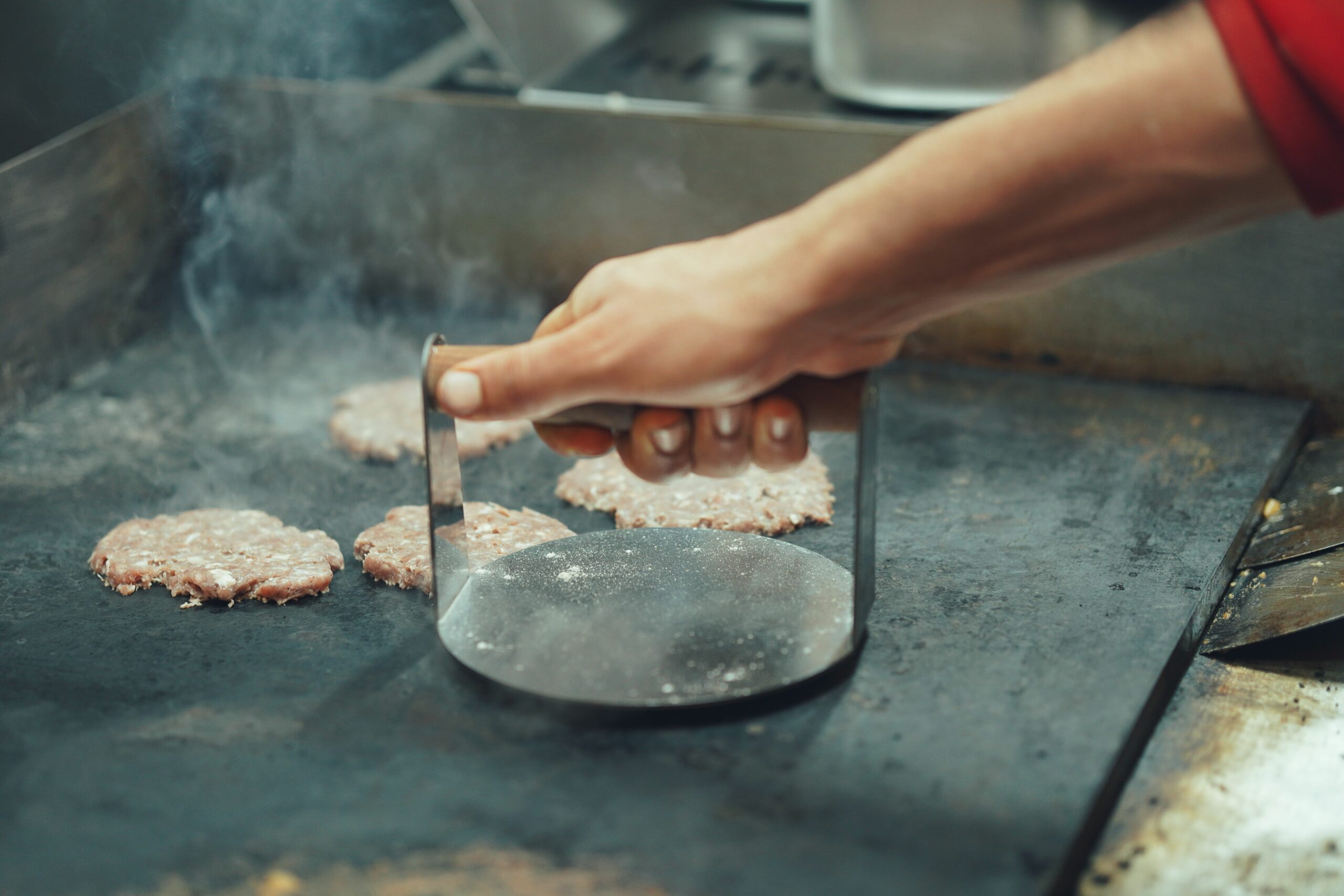
A smash burger is not simply a normal burger that somebody has flattened. The technique changes from the first second: a portion of meat is placed on a very hot flat surface and pressed immediately to create a thin layer with maximum contact. A traditional burger is shaped before cooking and retains substantially more thickness.
That geometric difference changes almost everything: cooking speed, browned surface, texture, crust-to-centre ratio and even the way the burger bites. Neither style is objectively superior. They pursue different culinary goals.
The key to smash: surface contact
Strong browning requires contact between meat and a sufficiently hot surface. A ball of mince touches the griddle over only a small area; pressing it at the beginning spreads the meat and multiplies direct contact.
That contact encourages Maillard reactions, responsible for many toasted aromas and the dark crust that defines a good smash burger. The purpose is not to “seal in juices”, but to generate flavour across a large proportion of the meat.
A traditional burger protects a larger centre
A thick patty has less relative surface area and more mass in the middle. This allows contrast between browned exterior and a softer, juicier centre. Cooking requires greater control because heat takes longer to reach the middle.
Its texture is closer to a compact piece of minced beef. In a smash burger, the focus moves towards crust, toasted edges and the combination of several thin layers.
Why pressing happens only at the beginning
In the smash technique, pressure is applied as soon as the meat hits the griddle. A crust has not yet formed and the goal is to spread the meat so the lower face makes complete contact.
Continuing to press later offers no equivalent advantage and can squeeze out rendered fat and liquid. This is different from repeatedly pressing a thick traditional burger with a spatula.
Griddle temperature matters enormously
A smash needs a surface capable of holding heat when the meat arrives. If the griddle is merely warm, the beef releases moisture, steams in its own liquid and fails to develop the crust we want.
A heavy steel or cast-iron surface works well, although a suitable pan can also do the job. Preheat properly and avoid loading so many portions at once that surface temperature collapses.
Open grill or flat griddle?
For smash burgers, a flat surface makes much more sense than open grill bars because continuous contact is essential. Over bars, part of the meat would hang between gaps and uniform pressure would be difficult.
A traditional burger works perfectly on grill bars. Its greater thickness lets it retain structure while heat acts without full-surface contact.
What fat level works best?
In both styles, a sensible amount of fat supports flavour and succulence. In a smash, fat also participates intensely in browning and partially fries the meat against the hot metal.
A very lean blend can dry rapidly because the patty is so thin. An excessively fatty blend, however, can lose a great deal of volume and flood the griddle. Balance depends on the beef available and the result you want.
You do not need a prestigious steak cut
A great burger does not require tenderloin. Grinding changes the original muscle structure, so blend, fat, freshness and handling become extremely important. Flavourful cuts that would not be a first choice for a steak can work beautifully when minced.
Paying purely for a famous anatomical name does not guarantee a better smash burger. Understanding the raw material and handling is more useful.
Handling: less is usually more
Overworking mince creates a compact texture. For smash burgers, lightly portioned balls that just hold together are normally enough. For a traditional burger, form a disc without unnecessarily kneading it.
Salt also changes proteins. If you want a loose burger texture, season in a way that suits the cooking technique rather than aggressively mixing salt through the entire batch far in advance.
Single or double smash?
Because one smash patty is thin, two patties are often stacked. This increases total crust without creating one thick centre. Cheese can be placed between layers and melts quickly.
A traditional burger creates volume with one thicker patty. The ratio between bun, meat and toppings is different, so a recipe designed for one style does not always translate well to the other.
Crisp edges are part of the style
When meat spreads irregularly, thin edges develop that brown deeply and can become slightly crisp. On a well-made smash burger this is not a shaping defect; it is part of the desired texture.
On a traditional burger, a more even shape helps maintain consistent thickness and predictable cooking.
How to lift it without losing the crust
After pressing, let the underside form a crust before trying to move it. A firm, thin-edged spatula can scrape against the griddle and lift the browned layer together with the patty.
Trying to flip too soon can cause sticking or tearing. The right moment comes once the lower surface has developed structure.
Smash burgers cook very quickly
Their small thickness means heat crosses the patty rapidly. The window between a well-developed crust and an overly dry burger is short. Have buns, cheese and toppings ready before you start.
A traditional thick burger gives more thermal margin at the centre, but internal cooking still needs careful control because minced meat must be cooked safely throughout.
Food safety: mince is not a whole steak
On an intact cut, microbiological contamination is initially concentrated mainly at the surface. Grinding can distribute that surface throughout the interior. A burger should therefore not be treated with exactly the same cooking logic as a rare whole steak.
The burger needs safe cooking through its full volume. A thin smash makes that comparatively straightforward because heat reaches the centre quickly; a thick traditional burger needs greater attention.
Which is juicier?
That depends on what you mean by juiciness. A thick burger can retain a larger moist centre. A smash compensates for its small interior with rendered fat, cheese, sauce and an intensely aromatic crust.
If your ideal is cutting into a burger and finding a substantial soft centre, traditional style fits better. If you want maximum browned flavour in every bite, the smash has a structural advantage.
Which has more flavour?
A smash generally produces more browned flavour per unit of meat because a much larger proportion of its surface undergoes Maillard reactions. A traditional burger preserves more of the meat's interior character in a less toasted centre.
This is not a contest between flavour and no flavour, but between two different distributions of flavour.
Which bun works best?
A double smash often benefits from a soft, not overly tall bun that compresses around the layers. A thick traditional burger can support a bun with somewhat more structure.
In either case, the bread should support the filling rather than force you to squeeze the burger so hard that everything escapes from the sides.
When to choose each style
- Smash: intense crust, toasted edges, very fast cooking and a thin or double burger.
- Traditional: a larger centre, contrast between crust and interior and a thicker patty.
- Flat griddle: strongly favours smash technique.
- Open grill bars: usually suit a formed, thicker burger better.
- Serving many burgers: smash is fast but requires organisation because each patty has a short cooking window.
Why burgers change size
Whether smash or traditional, meat loses some water and fat during heating. If you want to understand that separately, our guide to why burgers shrink during cooking explains what is normal and which techniques make it worse.
Frequently asked questions
Should you smash the burger several times?
No. The important pressure happens at the beginning to maximise contact with the griddle. After that, let the crust form.
Can you make smash burgers in a frying pan?
Yes, provided the pan handles heat well and offers enough flat area. A solid spatula is extremely useful.
Does a smash burger need more fat?
There is no universal figure, but an overly lean blend can dry very quickly. Balanced fat improves flavour and texture.
Is a double smash better than a traditional burger?
Not objectively. A double smash maximises crust; a traditional burger provides a thicker centre. Choose according to the experience you want.
Browse the meat and burgers currently available at El Mercado de Origen.
-
Sale!
 Select options
This product has multiple variants. The options may be chosen on the product page
Select options
This product has multiple variants. The options may be chosen on the product page

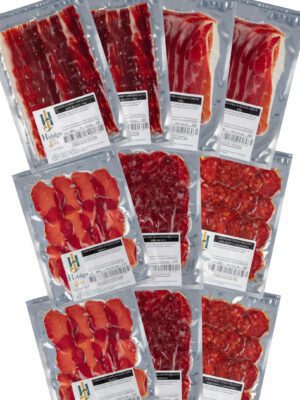 Tasting pack of 100% Iberian acorn (2x ham, 2x shoulder ham, 2x cured loin, 2x salchichón, 2x chorizo)
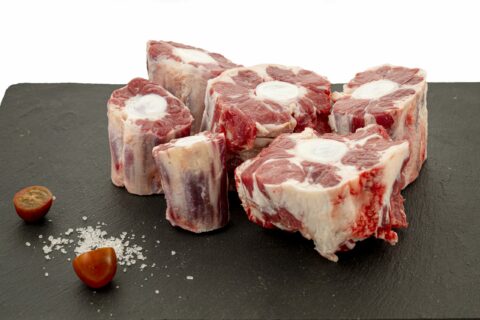
 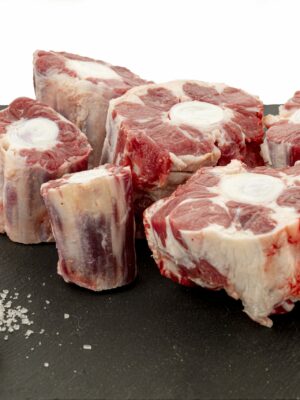 Oxtail
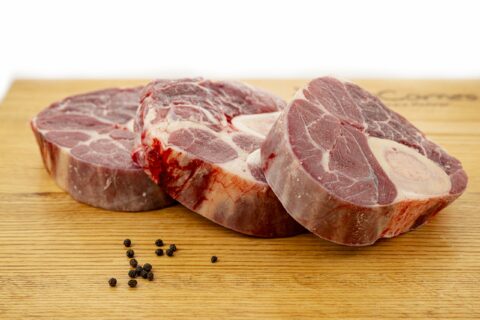
 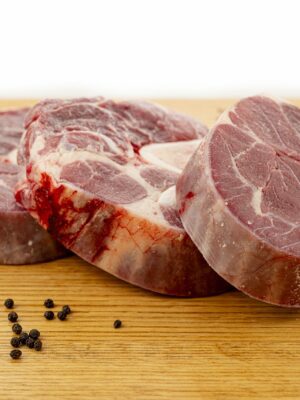 Beef osso buco
  12 Jars of Artisan Tomato Fritada, 314 ml
 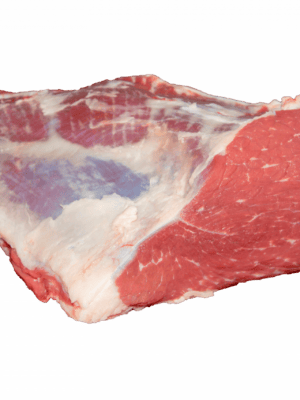 Beef picanha (rump cap)