
Iberian ham and Iberian cured loin are both cured pork products, but they are not nutritionally identical. Both can provide substantial protein, iron, zinc and B vitamins, while fat, moisture and salt can differ markedly between products.
Quick comparison
| Aspect | Iberian ham | Iberian cured loin |
|---|---|---|
| Protein | High; one acorn-fed 100% Iberian ham study reported ~35.8 g/100 g | Very high; studies and food tables commonly show roughly 35–50 g/100 g |
| Total fat | Highly variable with cut and visible fat | Variable, mainly intramuscular marbling within the muscle |
| Iron | Relevant source; one acorn-fed ham study reported ~2.76 mg/100 g | MAPA lists 3.7 mg/100 g for dry-cured loin |
| Monounsaturated fat | Usually predominant, particularly in acorn-fed ham | Also usually predominant; oleic acid is the main fatty acid |
| Salt/sodium | High and variable | High and variable |
Which has more protein?
Available references suggest that cured loin can equal or exceed ham in protein concentration. This is largely because loin is a relatively lean whole muscle and loses water during curing.
A study of 54 packs of acorn-fed 100% Iberian ham reported 35.79 g protein/100 g. Studies of Iberian cured loin have reported around 35.6–40.1 g/100 g, while MAPA's general dry-cured loin reference reaches 50 g/100 g. Our current acorn-fed 100% Iberian loin declares 46 g/100 g.
Which contains more fat?
This comparison depends heavily on the portion. A slice of ham may include very different amounts of visible outer fat, whereas loin fat is usually more integrated as intramuscular marbling.
The cited acorn-fed ham study reported an average of 26.34 g fat/100 g. In a sliced Iberian loin study, intramuscular fat ranged from approximately 8.9 to 14.5 g/100 g. The datasets are not perfectly equivalent, but they illustrate why cured loin can be leaner in many practical comparisons.
Similar fatty-acid pattern
Both products can have a predominantly monounsaturated fatty-acid profile, especially because of oleic acid. The ham study reported about 58.5% monounsaturated fatty acids, while studies of montanera Iberian loin have reported around 56%.
Which provides more iron?
Both provide animal-source iron. As reference values, the cited ham study reported around 2.76 mg/100 g, while MAPA lists 3.7 mg/100 g for dry-cured loin. This does not prove that every loin contains more iron than every ham; they are different products and datasets.
Vitamins and minerals
Both provide B vitamins. Iberian ham has been reported as a source of vitamins B1, B2, B3 and B6 plus minerals such as zinc, phosphorus, potassium and selenium. Dry-cured loin also provides B1, B3 and B12 together with iron and zinc.
Salt: a shared consideration
Both are cured with salt, and the final level varies with producer and curing conditions. Comparing the actual labels therefore matters as much as comparing the type of product.
So which is nutritionally “better”?
There is no universal winner. If your priority is very high protein with lower total fat, many cured loins may fit that goal better. If you compare flavour, texture, fatty-acid profile or a real serving rather than 100 g, the answer changes.
Conclusion
Iberian cured loin is generally highly protein-dense and may be relatively lean. Iberian ham can contain more total fat, especially when visible fat is eaten, while still having a monounsaturated-rich fatty-acid profile. Both provide iron and B vitamins. For an exact comparison, always use the nutrition labels of the two products you are actually choosing.
See also our guide to fat in Iberian ham and our explanation of caña de lomo and dry-cured loin.
Sources and how to read the figures
The figures in this article should be treated as reference values rather than a universal label for every Iberian cured loin. Final composition changes with the raw material, intramuscular fat, feeding system, recipe, salt content, degree of drying and producer.
The main references used are the Spanish Ministry of Agriculture (MAPA) food sheet for dry-cured loin and scientific studies on dry-cured Iberian loin. The MAPA sheet reports 50 g protein, 20.7 g fat and 3.7 mg iron per 100 g for dry-cured loin in general. Studies specifically analysing Iberian dry-cured loin have reported protein values around 35–40 g/100 g and meaningful differences in fat content between samples and commercial categories.
For that reason, when you need the exact value for a particular product, its own nutrition declaration takes priority. The acorn-fed 100% Iberian loin currently sold in our shop, for example, declares 46 g protein and 15 g fat per 100 g.
Related Iberian products
-
Sale!
 Select options
This product has multiple variants. The options may be chosen on the product page
Select options
This product has multiple variants. The options may be chosen on the product page
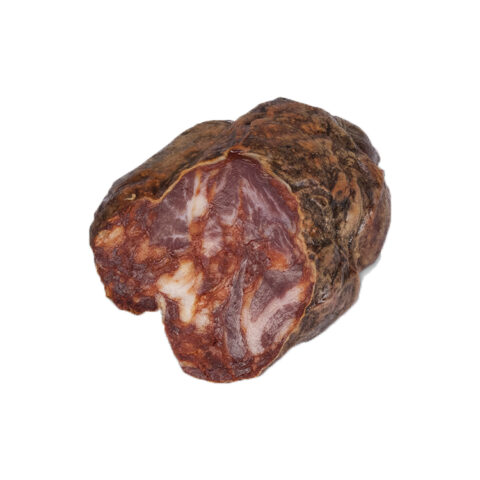

 100% Iberian acorn-fed morcón