
“Take the meat out of the fridge early so it can come to room temperature” is common cooking advice, but it is easy to take it too far. Taking some of the chill off the surface is not the same as leaving raw meat on the counter for hours. Long room-temperature holding does not guarantee better cooking and increases the time in which microorganisms can multiply.
A conservative home rule is to cook or refrigerate perishable food before it accumulates two hours at room temperature. In very hot conditions the margin is shorter. Food-safety authorities consistently recommend keeping the time outside temperature control as short as practical.
Related guides: beef protein per 100 g and by servinghow long beef and burgers keep frozenwhat the white foam when cooking meat isshop meat
Quick answer: how long can meat stay out?
Do not use the two-hour limit as a recommended “tempering” time. Treat it as a maximum safety boundary. In normal home cooking, take meat out when you are preparing the meal, season or portion it as needed and cook it without unnecessary delay.
- Thin steaks, burgers and minced meat: they do not need long periods at room temperature.
- Thick cuts: the surface can lose some chill while you prepare the pan, grill or oven, but the centre does not need to reach room temperature.
- Very hot weather: shorten the time further. USDA uses a one-hour limit when ambient temperature is above about 90 °F/32 °C.
Why hours of “tempering” are not necessary
The surface of refrigerated meat warms much faster than its centre. It is also the area most exposed to handling and the environment. Leaving a thick steak on the counter for several hours is therefore an inefficient way to warm the core while extending the time the surface spends in a favourable range for bacterial growth.
For even cooking, it is usually more useful to control thickness, heat level, internal temperature, oven-and-pan technique and the final resting period. Our guide to cooking beef according to the cut explains those variables in more detail.
The two-hour rule is a practical boundary, not a stopwatch
Food risk does not suddenly change at two hours and one minute. It depends on actual food temperature, room temperature, initial contamination, the type of meat and accumulated time. The two-hour rule is a practical conservative guideline that avoids having to make a microbiological calculation for every meal.
Time is cumulative. A long trip home from the shop followed by additional time on the kitchen counter is part of the same loss of cold-chain control.
Minced meat needs extra care
Mincing greatly increases surface area and can distribute organisms that were originally on the outside throughout the mixture. Minced meat is therefore a poor candidate for long room-temperature holding. Keep it cold, shape burgers quickly and refrigerate again if you are not cooking immediately.
What about thawed meat?
Meat thawed safely in the refrigerator should remain refrigerated until close to cooking time. Do not finish thawing it by leaving it out for hours. If the centre is still frozen, allow more refrigerator time instead.
This is separate from the question of refreezing. For that, see our guide to refreezing thawed meat.
A simple workflow before cooking
- Prepare the kitchen first. Get your pan, grill, tray and utensils ready.
- Take the meat out second. The clock then starts close to actual cooking.
- Pat the surface dry when useful. Excess moisture can inhibit browning.
- Season for the recipe. You do not need a long room-temperature rest simply because salt has been added.
- Cook with control. For thick cuts, an internal thermometer provides more information than surface colour.
- Return it to the fridge if plans change. Do not leave raw meat waiting on the counter for guests.
Can thorough cooking fix meat that was left out too long?
Cooking should not be used as a rescue strategy for poor storage. Heat destroys many microorganisms, but food safety starts before cooking. If perishable meat has spent excessive time at an unsafe temperature, the prudent option is not to try to compensate by cooking it harder or longer.
Smell is not a complete safety test either. Food can present a microbiological risk without developing an obvious unpleasant odour. Time and temperature history are more useful clues.
The key idea
You do not have to choose between safe handling and good cooking. Take meat out with enough time to prepare and cook it, not enough time to leave it on the counter for hours. Thickness, cooking temperature and resting after cooking matter much more than trying to bring the entire raw cut to room temperature.
Browse our meat selection if you are choosing a cut, then match the cooking method to the piece rather than relying on a long room-temperature wait.
-
Sale!
 Select options
This product has multiple variants. The options may be chosen on the product page
Select options
This product has multiple variants. The options may be chosen on the product page


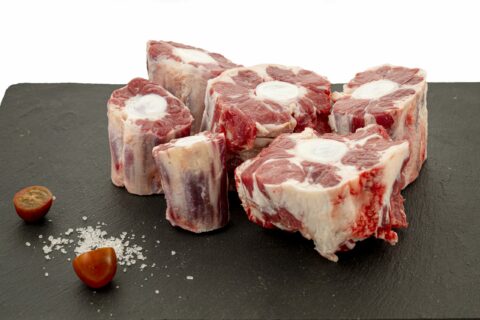


 Oxtail
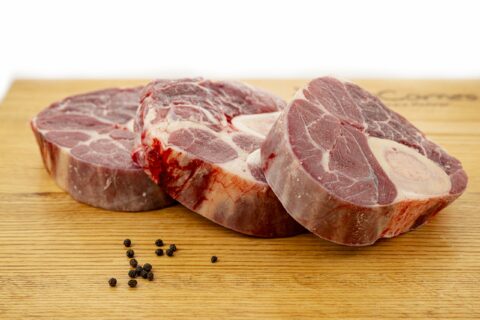
  Beef osso buco