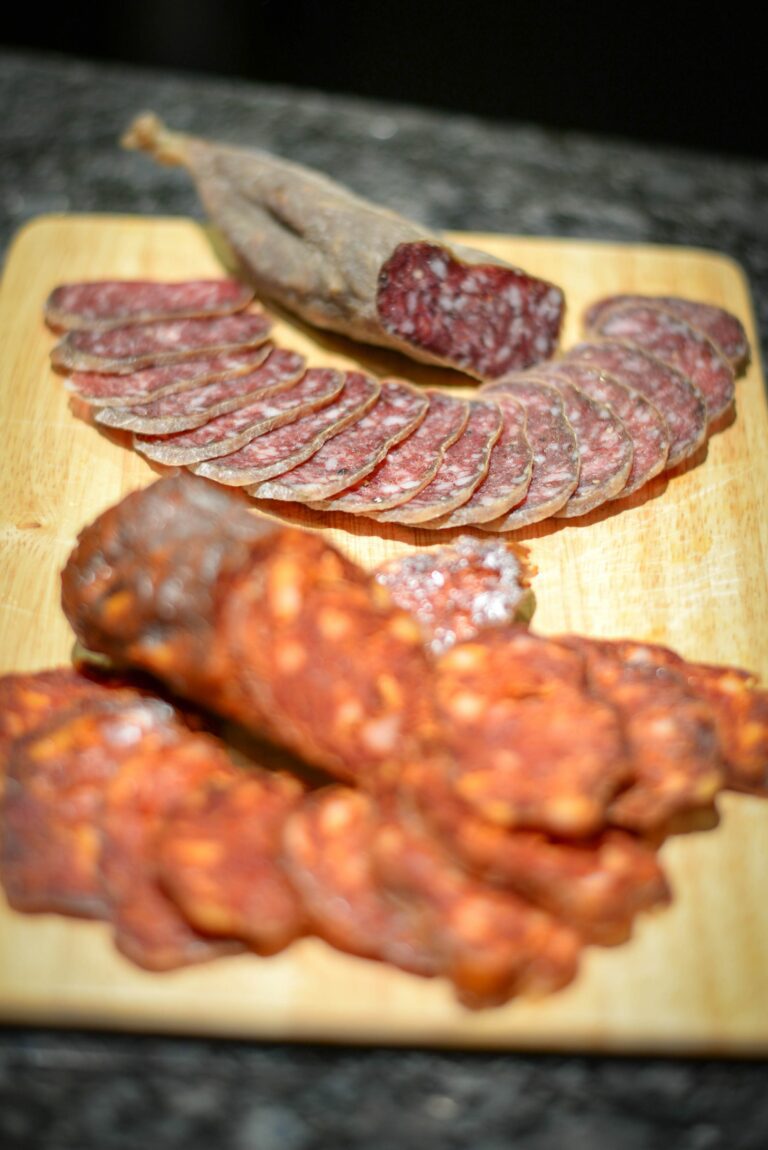
In everyday conversation, almost any sliced meat sold at a deli counter may be called a “sausage” or a “cold cut”: chorizo, salchichón, cooked ham, mortadella or turkey breast. Yet cured sausages and cold cuts are not exactly the same category, either in production method or in practical food terms.
The distinction helps you understand what you are buying, how it was made, what texture to expect and how it should be stored. It also prevents dry cured products from being grouped together with moist cooked meats that behave very differently.
Related cured-meat guides: when white mold on cured sausage is normalhow to freeze chorizo, salchichón and cured loinfresh vs cured chorizo and whether it needs cookingshop cured meats
Quick answer
A sausage or embutido is fundamentally linked to placing a meat preparation into a natural casing or artificial wrapper. Depending on the product it may then be sold fresh, fermented, cured, smoked or cooked.
A cold cut or fiambre is generally a prepared ready-to-eat meat product, commonly cooked and formed as a piece or block that is sliced for serving. Cooked ham, cooked turkey breast and mortadella are typical examples.
What makes a product an embutido?
The defining production step is placing the meat preparation into a casing or wrapper. The mixture may contain meat, fat, salt, spices and other permitted ingredients. It can then follow different routes.
- Cured and matured: many chorizos and salchichones.
- Fresh: some fresh chorizos and sausages that still require cooking.
- Cooked or scalded: other sausages receive heat treatment.
So “sausage” does not automatically mean dry, cured or ready to eat. The specific type matters.
For two classic Spanish cured products, see our guide to Iberian loin, chorizo and salchichón.
What is a fiambre or cold cut?
In common Spanish usage, fiambres are prepared meat products designed to be eaten cold and sliced. They are often moist, compact and heat-treated. Typical examples include cooked ham, cooked turkey breast, mortadella and other moulded cooked meats.
The formulations can vary widely. Two products that look almost identical may contain very different proportions of meat, added water, starch, proteins, salt and other ingredients. That is why the legal product name and ingredient list matter more than the picture on the front of the pack.
Is chorizo a cold cut?
Chorizo is more precisely described as an embutido. Cured chorizo also undergoes curing and maturation, giving it a lower-moisture, firmer texture and a more concentrated flavour than cooked ham.
Is salchichón a fiambre?
People may loosely include it on a “cold cuts” platter, but technically it is better described as a cured sausage. Meat and fat are minced, seasoned and matured to develop the characteristic texture and flavour.
Is cooked ham an embutido?
That is not the most useful description. Cooked ham is a heat-treated meat product usually presented as a formed piece or block for slicing. In everyday Spanish it clearly sits within the fiambre family.
What about cured pork loin?
Lomo embuchado is another useful example. It is not made from a minced sausage mixture like chorizo or salchichón. It starts with a whole muscle that is seasoned and cured. Although it is placed into a casing, gastronomically it makes more sense to describe it as a whole-muscle cured meat.
Practical differences when buying
| Aspect | Cured sausage | Cooked cold cut |
|---|---|---|
| Main process | Mincing/mixing, stuffing, curing or maturation | Formulation and heat treatment |
| Texture | Drier, firmer, more concentrated | Moister and softer |
| Flavour | Often stronger from spices and maturation | Often milder |
| After opening | Depends on curing and format | Usually strict refrigeration and relatively quick consumption |
| Examples | Cured chorizo, salchichón | Cooked ham, cooked turkey, mortadella |
Storage is different too
A whole cured sausage does not behave like moist sliced cooked ham. Curing reduces moisture and changes the food in a way that improves stability, but that does not make the product maintenance-free. Once opened or cut, protect the surface and follow the producer’s storage instructions.
Cooked cold cuts contain more moisture and normally require strict refrigeration. Pay particular attention to the use-by date and the manufacturer’s after-opening guidance.
For cured products, see our guide to storing chorizo, salchichón and cured loin after opening.
The most useful way to classify them
When you want to be precise, start with how the product was made. Chorizo and salchichón are cured sausages; cooked ham and cooked turkey are cooked cold cuts; lomo embuchado is a whole-muscle cured meat; and a fresh sausage is an embutido that still needs cooking.
This is more useful than calling everything at the deli counter “sausage”. It lets you compare similar products and understand why their flavour, texture and storage needs differ.