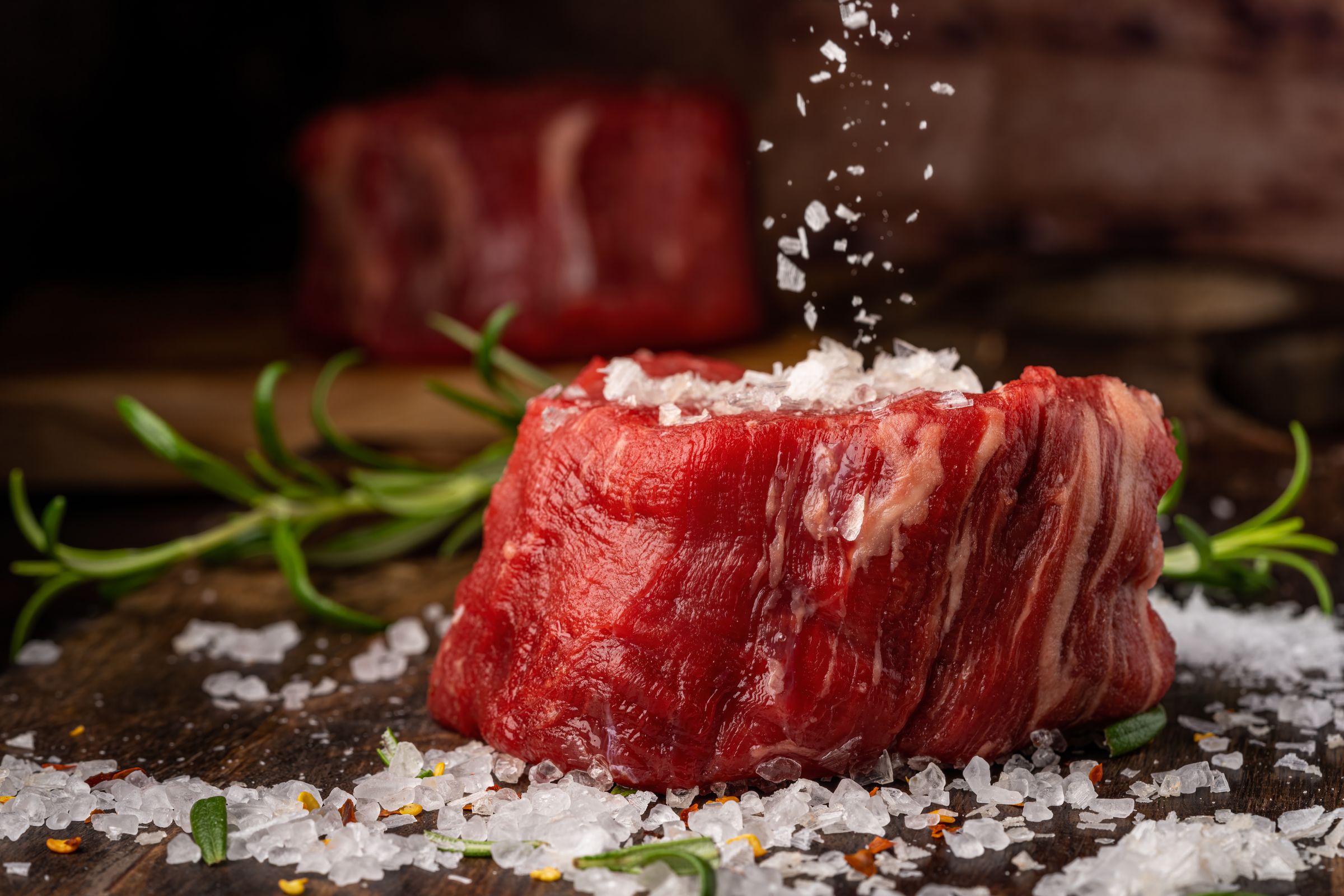
Should you salt meat before or after cooking? It sounds like a question with one correct answer, yet timing depends on the thickness of the cut, how much time you have and the cooking method. Fortunately, the practical rule is simple: for most steaks, either salt immediately before cooking or salt well in advance.
The awkward middle ground is salting and then leaving the meat for a short period while moisture collects on the surface without enough time for the seasoning to redistribute. Understanding the process makes the choice much easier.
What salt does to meat
Salt does more than make beef taste salty. On the surface it draws out moisture, dissolves into that liquid and can gradually move back into the outer layers. Given enough time, this seasons a thick cut more evenly than adding salt only after cooking.
Amount matters as much as timing. Good beef does not need to be buried under salt unless a particular technique calls for it. Start moderately; you can always add a little more at the table.
Option 1: salt immediately before cooking
If you are cooking now, salt the meat immediately before it goes into the pan, griddle or grill. Pat the surface dry, season it and start cooking rather than leaving it to sit.
This method is especially convenient for thin steaks, formed burger patties and everyday meals. The salt has not had much time to pull visible moisture onto the surface, so browning can begin efficiently in a properly preheated pan.
Option 2: salt well in advance
With thicker cuts, you can season ahead and keep the beef refrigerated. Moisture first appears on the surface, dissolves the salt and then some of that seasoned liquid redistributes into the outer part of the meat.
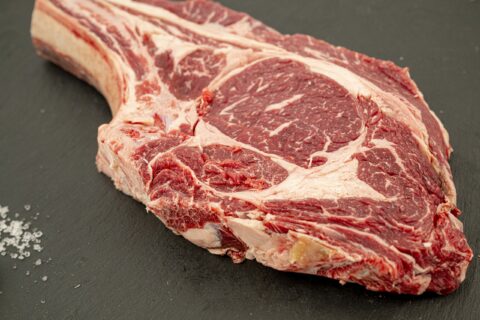
For a thick rib steak, entrecôte or tomahawk, salting several hours ahead and keeping the cut refrigerated on a tray or rack can also help the surface become drier by cooking time. A dry exterior promotes browning.
This technique is often called dry brining. No water is added; it relies on salt and time.
How far in advance?
There is no universal minute count. Thickness changes everything. A thin steak needs much less time than a cut several centimetres thick. As a practical cooking guide, if you are not salting immediately before cooking, give the salt enough time to work: roughly an hour for moderate pieces through to several hours or overnight for thick steaks.
During that time, keep the meat refrigerated. Salting early is not a reason to leave raw beef at room temperature for hours.
Why the short middle interval can be awkward
A few minutes after salting, small beads of moisture often appear. If you cook at that moment without drying the surface, that water must evaporate before strong browning can begin.
The steak is not ruined, but searing may be slower. If the surface is visibly wet, pat it dry gently and avoid overcrowding the pan. This connects directly with our guide to why meat releases water in the pan.
Is salting after cooking wrong?
No. Finishing salt is completely valid, especially when you want to control seasoning bite by bite or use flaky salt for texture. The difference is that most of the flavour remains on the surface rather than moving inward.
On a thick steak, relying only on finishing salt can leave the crust well seasoned while the centre tastes relatively neutral. On a very thin steak, the difference is much smaller.
Fine salt, coarse salt or flakes?
Crystal size changes how easily salt can be measured and distributed. Fine salt dissolves quickly; coarse salt makes it easier to see where you have seasoned; flakes are particularly pleasant as a finishing salt because they add small bursts of texture.
There is no compulsory steak salt. What matters is learning the density of the one you use. A teaspoon of very fine salt can contain considerably more actual salt than the same volume of large, airy crystals.
When to salt a thin steak
For a thin veal or beef steak, the simplest method is to dry the surface, salt immediately before cooking and use strong heat for a short time. The cooking window is so brief that you do not need to turn seasoning into an hours-long process.
Our guide to cooking tender, juicy beef steaks covers pan temperature, thickness and resting in more detail.
When to salt a thick rib steak or entrecôte
With a thick cut, advance seasoning makes more sense because there is more meat to season. Salt several hours ahead if convenient, keep it refrigerated and check that the surface is dry before cooking.
Salt does not replace doneness control. For a thick steak, a thermometer is more reliable than guessing by minutes. See our beef doneness temperature guide.
When to salt a tomahawk
A tomahawk follows many of the same principles as a thick rib steak. Its size makes advance salting useful, followed by careful internal-temperature control. Bone and thickness make simple time estimates unreliable.
Our tomahawk guide compares pan, grill and oven approaches.
What about burgers?
With burgers, distinguish between salting the outside and mixing salt thoroughly into raw ground beef. Working salt into the mince can change how the proteins bind and create a firmer, springier texture similar to some sausages.
For a loose, juicy burger, form the patty first and season the surface immediately before cooking. If you deliberately want a bound meat mixture for another preparation, the technique can be different.
See our juicy beef burger guide for the full method.
Should stewing beef be salted before browning?
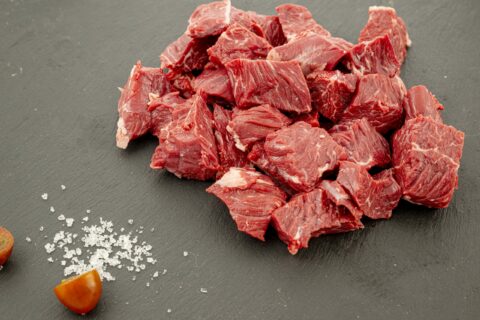
You can season cubes lightly before browning, particularly if you are working in batches. Adjust the final seasoning later because braising liquid reduces and becomes more concentrated.
Salt from stock, cured ingredients, sauces and other components also counts. Taste before making the final correction.
Does salt make meat dry?
Used properly, salt does not automatically make beef dry. Juiciness depends far more on doneness, cut, thickness and fat level. Advance salting can improve seasoning without requiring a heavy final dose.
Overcooking is much more likely to dry a steak. Lean cuts give you even less margin, as explained in our lean beef guide.
Does salting before cooking prevent a crust?
No, provided the surface is managed properly. Browning needs enough heat and limited surface moisture. A steak salted well in advance and refrigerated can be very dry at the surface, while a steak salted immediately before cooking can also brown extremely well.
Problems arise when the pan is cool, the meat is wet or too many pieces are added at once. Water then has to evaporate before the surface can brown efficiently.
How to season evenly
- Pat the meat dry before seasoning.
- Sprinkle from a little height for a more even distribution.
- Season both sides and the edges of very thick cuts.
- If salting in advance, keep the meat refrigerated.
- Do not automatically add another heavy layer of salt at the end.
- Remember that sauces, seasoned butter and side dishes may already be salty.
Common salting mistakes
- Using the same volume of fine salt and flaky salt without considering density.
- Leaving salted raw beef at room temperature for hours.
- Cooking while the surface is visibly wet without drying it.
- Mixing lots of salt into burger mince when a loose texture is desired.
- Expecting salt to fix overcooked meat.
- Adding a large finishing dose without tasting first.
Frequently asked questions
Is it better to salt before or after?
For most steaks, immediately before cooking or well in advance both work very well. Salting after cooking is useful as a finish but mainly seasons the surface.
Can I salt steak the day before?
For thick cuts, yes, provided the meat stays refrigerated and the amount of salt is sensible.
How long should meat sit out after salting?
It does not need to sit out for hours. If you salt in advance, keep it refrigerated and organise the cooking safely.
Should a burger be salted before cooking?
Form the patty first, then salt the outside immediately before cooking if you want a loose, juicy texture.
Salt is part of the technique, not a rule on its own
The best timing depends on the cut and your schedule. For a quick dinner, immediate seasoning is ideal. For a thick rib steak, several hours can improve both seasoning and surface dryness. The best results come from combining salt timing with refrigeration, drying and accurate doneness.
-
Sale!
 Select options
This product has multiple variants. The options may be chosen on the product page
Select options
This product has multiple variants. The options may be chosen on the product page



 Lean diced beef / beef ragout