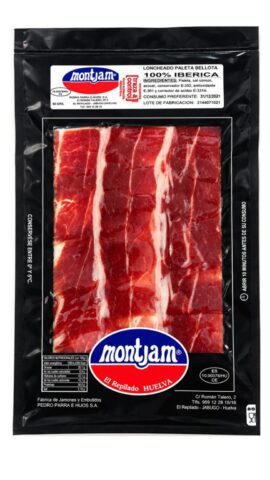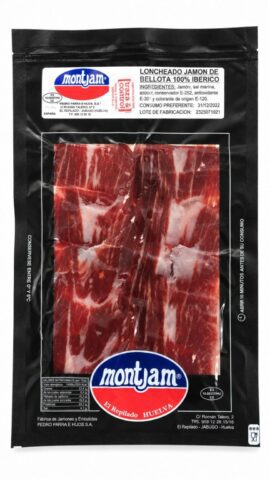
When people discuss the fat in Iberian ham, two opposite simplifications often appear: “it is animal fat, so it is mostly saturated” or “it is basically like olive oil”. Neither statement describes the food accurately. Iberian ham fat is a mixture of different fatty acids and, in many products —particularly hams from acorn-fed pigs—, monounsaturated fatty acids make up the largest fraction.
That does not make ham equivalent to olive oil, and it does not mean every Iberian ham has the same profile. The pig's diet, genetics, the tissue sampled, how much visible fat is eaten, curing and normal biological variation all matter.
Quick answer: which fats are present in Iberian ham?
The fatty acids can be grouped into three main families:
- Monounsaturated fats: often the largest fraction, with oleic acid as the main component.
- Saturated fats: present in a substantial proportion, especially palmitic and stearic acids.
- Polyunsaturated fats: generally present in smaller proportions, including linoleic acid.
For a concrete example, a study of 54 samples of 100% Iberian acorn-fed ham reported that roughly 58% of the fatty acids were monounsaturated, 34% saturated and 8% polyunsaturated. Oleic acid accounted for just over half of total fatty acids. This is useful for understanding the general profile, but it should not be treated as a universal nutrition table for every Iberian ham.
Monounsaturated fat and the role of oleic acid
Oleic acid is the most characteristic monounsaturated fatty acid in Iberian pig fat. It is also the main fatty acid in olive oil, which is why the two foods are sometimes compared.
The similarity concerns the importance of oleic acid within the fat fraction. Ham is still a cured meat containing protein, salt, minerals and several types of fatty acids, whereas extra virgin olive oil is almost entirely fat and has its own minor compounds. Sharing a dominant fatty acid does not make the two foods nutritionally equivalent.
In Iberian pigs, oleic acid content is influenced by both metabolism and diet. Acorns are rich in oleic acid and the montanera finishing period can clearly alter the fatty-acid profile. This is one reason oleic acid is useful when researchers study differences among acorn-fed, free-range feed-finished and conventionally feed-finished Iberian hams.
Which saturated fats does it contain?
Palmitic acid and stearic acid are usually among the main saturated fatty acids. Their presence is why it is misleading to describe Iberian ham as a food with no saturated fat. The actual amount depends on the product and on how much adipose tissue is included in the slice.
It is also useful to separate two questions: the percentage of each fatty acid within the fat, and the total grams of fat that are eaten. A very lean slice and a slice with a generous band of white fat may have a broadly similar relative profile but deliver very different absolute amounts of fat per serving.
What about polyunsaturated fats?
The polyunsaturated fraction is generally smaller than the monounsaturated and saturated fractions. Linoleic acid —an omega-6 fatty acid— is usually the main component of this group. Smaller amounts of other polyunsaturated fatty acids may also be present.
Diet again matters. Feed ingredients provide different fatty acids, and adipose tissue reflects part of those differences. This is why fatty-acid profiling can be used as a complementary research tool when studying the feeding regime of Iberian pigs.
Acorn-fed, free-range feed and feed: why the profiles differ
Research on Iberian ham shows a consistent trend: acorn feeding during montanera is associated with a higher proportion of oleic acid and monounsaturated fatty acids. In studies comparing commercial feeding categories, oleic acid is one of the variables that contributes most strongly to distinguishing acorn-fed samples from feed-finished samples.
This does not mean that one laboratory number can infallibly identify the commercial class of any ham. Breed, management, length of montanera, the exact diet and the sampling site all introduce variation. Commercial classification must come from the official traceability and labelling system rather than a single nutritional measurement.
Visible fat changes what you actually eat
A composition table analyses a defined sample. At home, one person may trim most of the outer fat while another eats it together with the lean portion. That choice obviously changes the grams of fat and energy in the serving.
When comparing hams nutritionally, use data reported on a comparable basis. Do not compare a “lean edible portion” table with another analysis that includes a large amount of external fat and assume the difference is caused by breed or feeding alone.
Does curing change the profile?
During curing, water is lost and enzymatic and oxidative reactions create the characteristic aroma and texture. Water loss concentrates many components per 100 grams. Lipids also participate in reactions that generate flavour compounds.
This is why figures for 100 g of cured ham cannot simply be transferred to fresh pork. It also helps explain differences among hams with different curing times and degrees of drying.
How to read a nutrition label
A label will normally list total fat and saturates. It usually does not show how much is oleic acid, monounsaturated fat or polyunsaturated fat unless the producer provides additional information.
To compare two products, first check total fat per 100 g, saturated fat per 100 g and salt. Then consider the serving you actually eat. If one slice includes much more visible fat, the amount eaten can matter more than small percentage differences in the composition of that fat.
Bottom line
Iberian ham fat is not exclusively saturated. It often contains a high proportion of monounsaturated fatty acids, with oleic acid as the main one, together with saturated fat and a smaller polyunsaturated fraction. Acorn-fed Iberian ham tends to be particularly rich in oleic acid because of the feeding regime during montanera.
The important point is to avoid universal numbers. The profile varies with feeding, genetics, the cut and the sample analysed, while the total amount eaten also depends on how much visible fat remains on the slice. For more detail, see our guides to oleic acid in Iberian ham and how acorn feeding changes the fat.