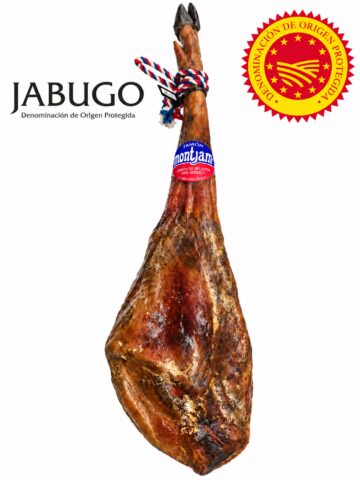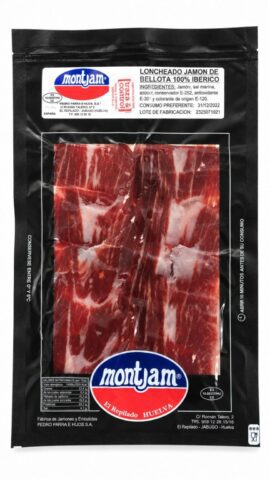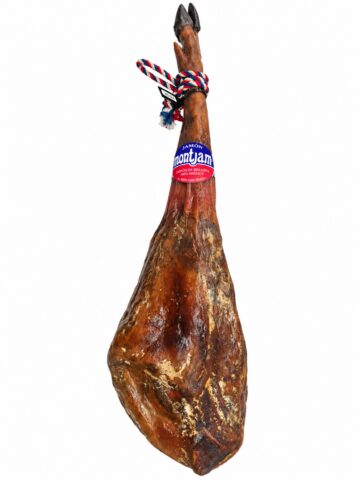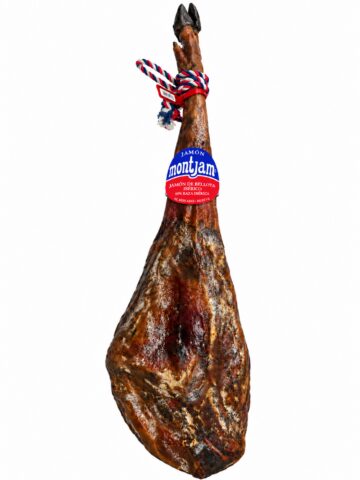
Buying Iberian ham looks simple until the same counter presents 100% Iberian acorn-fed, Iberian acorn-fed, free-range feed-fed, feed-fed, 50%, 75%, black seal, red seal, green seal and white seal. These terms belong to the same legal system, but they do not describe the same thing. The most common mistake is to mix up two separate questions: how much Iberian breed ancestry the animal has and how it was fed and managed during the regulated finishing stage.
The clearest way to understand Spanish Iberian ham is to separate those two dimensions. Spain's Iberian Quality Standard, established by Royal Decree 4/2014, defines the commercial designations and the colour-coded seals used on hams and shoulders. Once you know the logic, the label becomes a useful technical summary rather than marketing jargon.
The key idea: feeding and breed are different variables
Acorn-fed, free-range feed-fed and feed-fed describe feeding and management. 100%, 75% or 50% Iberian describes breed percentage. A complete designation combines the two.
| Information | What it tells you | Examples |
|---|---|---|
| Feeding/management | How the pig was finished and managed | Acorn-fed, free-range feed-fed, feed-fed |
| Breed percentage | Proportion of Iberian genetics | 100%, 75%, 50% Iberian |
| Seal colour | Quick legal category identifier | Black, red, green, white |
This is why both a 100% Iberian acorn-fed ham and a 50% Iberian acorn-fed ham can exist. They share the acorn-fed finishing category but not the same breed composition.
The four official seals
| Seal | Category | Feeding/management | Breed |
|---|---|---|---|
| Black | Acorn-fed 100% Iberian | Montanera under the legal requirements | 100% Iberian |
| Red | Acorn-fed Iberian | Acorn and natural dehesa resources during montanera | 50% or 75% Iberian |
| Green | Free-range feed-fed Iberian | Feed plus outdoor/field management under the standard | Different permitted Iberian percentages |
| White | Feed-fed Iberian | Mainly cereal and legume feed in regulated intensive systems | Different permitted Iberian percentages |
Our dedicated guide to the black, red, green and white Iberian ham seals focuses on reading the colour system. Here the goal is broader: understanding what the production categories actually mean.
What acorn-fed really means
The term acorn-fed is not a decorative claim that can be added to any Iberian ham. Under the regulated system it identifies pigs that meet the conditions for the montanera, the traditional finishing period in the dehesa where animals forage on acorns, grass and other natural resources under defined requirements involving dates, age, weight gain and stocking conditions.
Montanera combines diet, movement and environment. It is not simply a pig being given a few acorns. The animal moves through the dehesa to forage and gains weight during this period, influencing the raw material that later enters the curing process.
There are two acorn-fed seals. Black adds the requirement of 100% Iberian breed. Red identifies acorn-fed Iberian ham from 50% or 75% Iberian animals.
Is red-seal acorn-fed ham worse than black-seal ham?
The black seal represents a narrower legal combination: acorn-fed plus 100% Iberian breed. The red seal shares the regulated acorn-fed finishing system but comes from crossbred animals. That distinction matters, but it does not allow you to predict every sensory detail of an individual ham.
Genetics are only one part of quality. Salting, piece weight, fat distribution, drying, cellar maturation and producer skill also shape the final result. Black identifies a more restrictive category; it does not replace good craftsmanship.
What free-range feed-fed Iberian ham means
Free-range feed-fed Iberian ham, identified by a green seal, comes from animals fed mainly on cereal and legume feeds while being managed outdoors or in field conditions according to the standard. It is not simply “acorn-fed but with fewer acorns”. It is a different regulated production route.
For many buyers this category offers an attractive middle ground between flavour, fat development and price. But it should be understood on its own terms rather than presented as a lesser version of montanera.
The green seal does not by itself tell you whether the animal is 50%, 75% or 100% Iberian. Read the full sales designation for the breed percentage.
What feed-fed Iberian ham means
Feed-fed Iberian ham carries a white seal. The pigs are fed mainly on formulated feeds in regulated intensive production. This category is generally the most accessible route into certified Iberian ham.
Feed-fed does not mean “bad ham”. It identifies a different production category. A skilled producer can make balanced, enjoyable feed-fed ham, while poor curing can compromise more expensive raw material. What changes is the production system and therefore the starting material, not the basic need for careful curing.
What does 100% Iberian mean?
100% Iberian is reserved for products from animals whose parents meet the required pure Iberian genealogical conditions. It does not automatically mean acorn-fed. Breed percentage and feeding designation remain separate.
The useful buying question is therefore not “Is it 100% or acorn-fed?” but “What is the breed percentage, and what is the feeding category?”.
What do 75% and 50% Iberian mean?
When a product is not 100% Iberian, the percentage of Iberian breed must be stated as required by the standard. These percentages arise from regulated crosses, commonly involving Duroc on the non-Iberian side.
The percentage is not a score out of 100 for overall quality. It is breed information. A 50% Iberian acorn-fed ham is still legitimately acorn-fed; a 100% Iberian feed-fed ham is still feed-fed. Those examples show why both dimensions matter.
What about “pata negra”?
The expression pata negra has historically been used too loosely. Under the current standard, the protected use corresponds to acorn-fed 100% Iberian. A dark hoof by itself is not proof of category, because hoof colour is not a reliable substitute for traceability and labelling.
Does “recebo” still exist as a current category?
Recebo is not one of the current designations under Royal Decree 4/2014. You may encounter it in older books, historic labels or conversations, but current certified Iberian products should be read using the present categories: acorn-fed, free-range feed-fed and feed-fed, combined with breed percentage.
How taste and texture tend to differ
Acorn-fed ham is commonly associated with particularly fluid fat, long aromatic persistence and a complex profile that reflects both the raw material and extended maturation. A strong free-range feed-fed ham can offer excellent juiciness and balance. Feed-fed ham may present a more direct profile at a lower price point.
These are tendencies, not guarantees. The seal does not cure the ham. Salt, temperature, humidity, maturation time, piece anatomy and producer decisions remain decisive. Two hams with the same seal colour can still taste noticeably different.
Does acorn-fed always mean a longer curing time?
No legal equation says “black seal equals 48 months” or “white seal equals 24 months”. Minimum processing periods are regulated separately, and real maturation depends on the piece. Our guide to how long Iberian ham is cured explains that distinction in detail.
How to read an Iberian ham label in 30 seconds
- Identify the cut: ham or shoulder.
- Find the feeding designation: acorn-fed, free-range feed-fed or feed-fed.
- Read the breed percentage: 100%, 75% or 50% Iberian where applicable.
- Check the seal colour: black, red, green or white.
- Then compare producer, weight and format.
- Treat curing months as extra information, not as a substitute for the legal designation.
Which category should you choose?
If the ham is the centrepiece of a celebration, a premium gift or a tasting where you want maximum depth, acorn-fed is the natural place to look. For frequent consumption with a strong balance between character and budget, free-range feed-fed can be compelling. For a more accessible introduction to certified Iberian ham, a well-made feed-fed piece can make perfect sense.
Within the chosen category, consider producer, weight and whether you want a whole piece or sliced packs. If you are deciding between the rear and front leg, see our guide to Iberian ham versus shoulder.
The definitive rule
Remember one sentence: acorn-fed, free-range feed-fed and feed-fed describe feeding and management; 100%, 75% and 50% describe breed; black, red, green and white are the official seals that summarise the legal category.
Black is acorn-fed 100% Iberian. Red is acorn-fed Iberian at 50% or 75%. Green is free-range feed-fed Iberian. White is feed-fed Iberian. Once you understand this architecture, the price differences become easier to interpret and the word “Iberian” stops being an imprecise catch-all.
Iberian hams and shoulders
-
-
EMDO Selection
-