When a cured ham is sliced, not every slice has exactly the same colour. Some look bright red or garnet, others are much darker, while heavy marbling can make another section look visually lighter. This variation can be surprising within one piece, but cured ham is not uniform in colour because its muscles, fat distribution and curing behaviour are not uniform either.
A darker slice does not by itself mean that the ham is better, worse, more Iberian or spoiled. Colour needs to be interpreted alongside the anatomical section, muscle, moisture, curing, exposure to air and the condition of the fat.
A ham contains different muscles
Although we refer to “a ham” as one piece, it contains several muscles with different structures and compositions. They vary in water, pigments, fat and connective tissue.
As the knife progresses, you can therefore move from a relatively bright red area to a deep garnet one without anything being wrong. The transition may even coincide with a visible anatomical boundary.
Maza and babilla do not look identical
Different sections behave differently during curing. The maza is relatively bulky and often retains a more succulent feel, while the narrower babilla can lose moisture more readily.
These differences affect colour. A leaner, drier section may look more concentrated and dark. Our guide to the parts of Iberian ham explains why slice size, fat and texture change through the same piece.
Myoglobin contributes to meat colour
Muscles contain myoglobin, a pigmented protein involved in oxygen storage. Its concentration and chemical state influence meat colour. In a cured product, this pigment system changes alongside many other reactions.
Cured ham should not be imagined as fresh meat that has merely dried. Salt, time, moisture loss, enzymes and oxidation progressively transform appearance and aroma.
Moisture loss concentrates appearance
As a muscle loses water, its solid components become more concentrated. In some areas this contributes to a darker, denser appearance. Two muscles that dry at different rates can finish with noticeably different tones.
This also explains why a very dry area may look visually intense. If the texture is hard as well, separate the colour question from the issue addressed in our guide to ham that is too dry.
Marbling changes the visual impression
A slice crossed by many fine streaks of fat looks lighter because ivory fat interrupts the red muscle. A leaner slice can appear dramatically darker even when its muscle has developed completely normally.
This is why comparing photographs from unknown sections can produce misleading conclusions about quality or category.
Does darker mean longer curing?
Not necessarily. Longer curing can involve more moisture loss and colour change, but final appearance depends on many variables: piece size, muscle, fat, temperature, humidity and individual maturation.
Colour cannot reveal the exact number of curing months, nor can it distinguish acorn-fed, field-fed or other commercial categories by itself.
What happens when a fresh cut meets air?
Exposure to oxygen and light can alter the appearance of a freshly cut surface slightly. What you see at the instant the knife passes is not always identical to the colour a few minutes later.
At the same time, fat becomes more translucent as it warms, changing the visual contrast between fat and muscle even though the actual quality has not changed.
Temperature changes how ham looks
A very cold slice looks more rigid and its fat more opaque. As it warms, the fat becomes glossy and translucent and the overall slice can seem more vivid. Room lighting also strongly affects our perception of reds and garnets.
Our article on why Iberian ham “sweats” explains how temperature affects fat, gloss and aroma.
Does darker mean stronger flavour?
There is no simple equivalence. A drier, leaner section can taste more concentrated, but flavour also depends on fat, salt, protein breakdown, lipid reactions and aromatic compounds developed during maturation.
A lighter, well-marbled slice can be extremely aromatic; a dark slice is not automatically more complex. Colour is a characteristic, not a score.
Colour does not prove Iberian status
A deep red tone does not certify breed. Just as a black hoof alone cannot establish legal product identity, dark muscle cannot replace the label and official seal.
When determining the commercial category, documentary information is more reliable than a photograph of the slice.
When colour variation is normally expected
Gradual differences between muscles, lean areas, sections with varying marbling and surfaces exposed differently to air are common. If aroma is clean, fat appears normal and texture fits the section, variation from red to deep garnet usually belongs to the natural heterogeneity of the ham.
Small differences between the centre and edge of a slice can also reflect moisture, cutting and air contact.
When colour should make you check other signs
Colour alone rarely diagnoses a problem. However, a striking abnormal appearance accompanied by persistent unpleasant odour, sliminess, clearly rancid-tasting fat or extensive unusual areas should be assessed differently.
In that situation, do not dismiss the whole pattern as simply a normal dark section. Consider all signs and the storage history.
Dark is not the same as rancid
Rancidity mainly concerns oxidative changes in fats and is detected primarily through aroma and flavour. A dark muscle area can have completely sound fat.
If smell is the concern, our guide to rancid versus normal cured-ham aromas is more useful than judging muscle colour alone.
What about yellow fat?
Fat colour is a separate variable. Ivory or yellowish fat can depend on surface oxidation, age, feeding, exposure and anatomical area. Do not automatically link dark muscle with yellow fat.
Those are different observations and should be interpreted separately.
How to compare slices more meaningfully
- Compare slices from similar sections, not opposite ends of the ham.
- Use neutral lighting.
- Take marbling into account.
- Do not judge a slice while it is excessively cold.
- Assess aroma, flexibility and flavour as well.
- Use the label and official seal for commercial category, not colour.
A natural piece will not stay one identical shade from end to end
Slices from one ham can be lighter or darker because they come from different muscles and sections with different fat and moisture loss. Curing accentuates this natural diversity rather than erasing anatomy.
Understanding that variation avoids two common mistakes: treating every colour change as a defect or using an unusually dark slice as supposed proof of superior quality.
Related hams and shoulders
-
Sale!
 Select options
This product has multiple variants. The options may be chosen on the product page
Select options
This product has multiple variants. The options may be chosen on the product page
-
Sale!Select options
This product has multiple variants. The options may be chosen on the product page
-
EMDO Selection SaleSale!Select options
This product has multiple variants. The options may be chosen on the product page
-
EMDO Selection SaleSale!Select options
This product has multiple variants. The options may be chosen on the product page
-
 100% mature beef burgers – gluten-free (2)
  100% beef burgers – gluten-free (2)
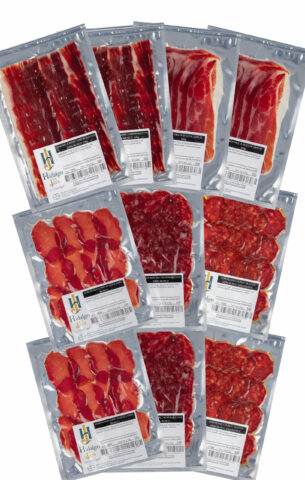
 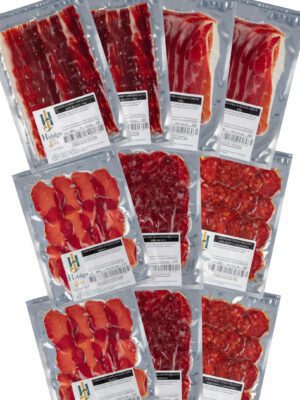 Tasting pack of 100% Iberian acorn (2x ham, 2x shoulder ham, 2x cured loin, 2x salchichón, 2x chorizo)