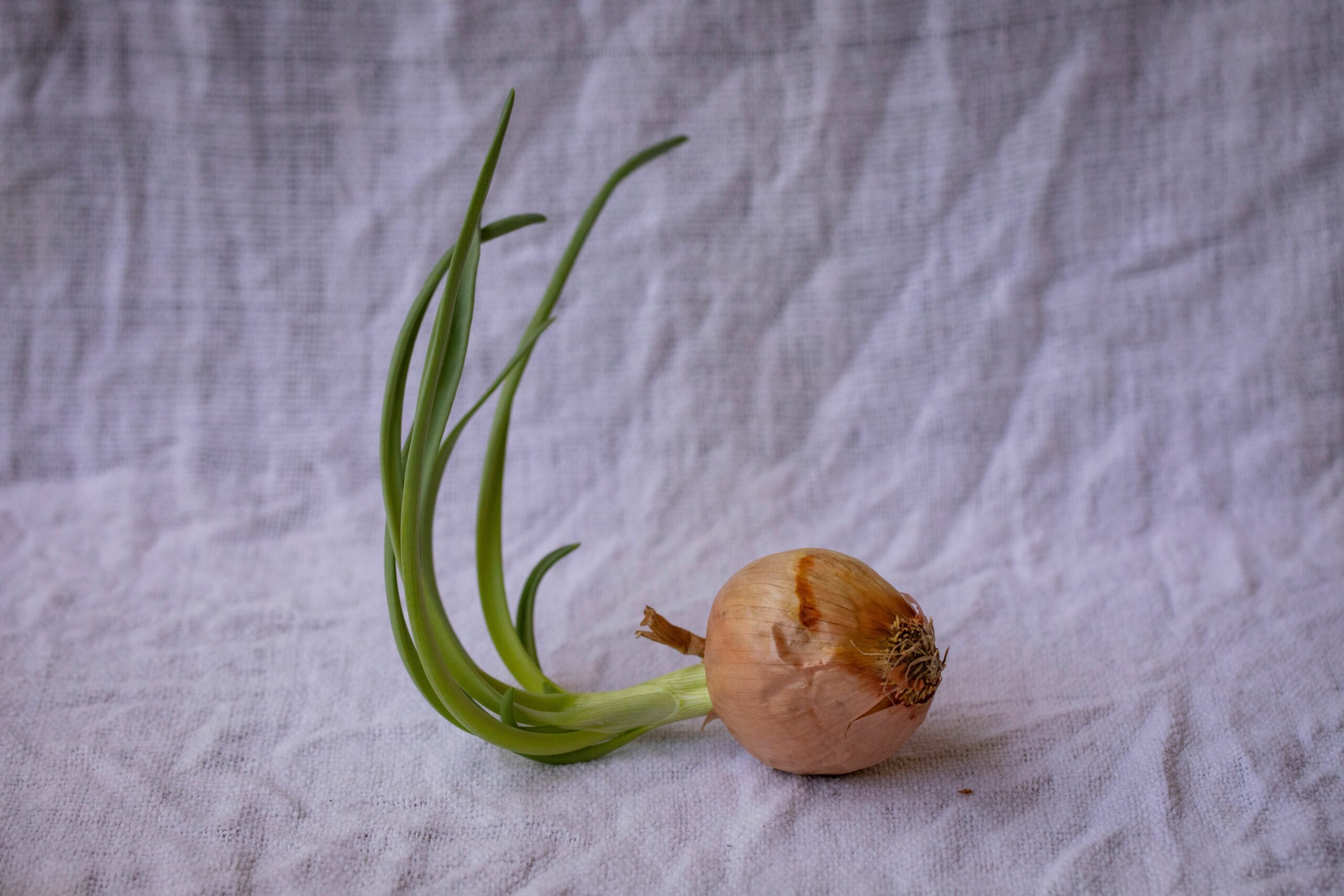
An onion that starts producing a green shoot has not suddenly become toxic. The bulb has left dormancy and begun using its stored reserves to grow new leaves. Sprouting is a sign of ageing and renewed growth, not automatic evidence of spoilage.
The useful question is how the rest of the onion looks and feels. A firm, dry bulb without mould may still be perfectly usable; a soft, wet, slimy or foul-smelling one is a different situation.
Why onions sprout
An onion bulb is a storage organ. After harvest it can remain dormant, but temperature, humidity, variety and storage duration all influence when growth resumes. Once dormancy breaks, a shoot emerges from the centre.
Growth consumes sugars and water stored in the bulb. A heavily sprouted onion can therefore feel lighter, slightly hollow or less juicy than a fresher one.
Can you eat an onion with a green shoot?
Yes, if the bulb itself is sound. Remove the dry outer skins, cut it open and inspect the layers. If they are firm, smell normal and show no mould or rot, the shoot alone is not a reason to throw the onion away.
Culinary quality may have changed. As reserves are used, some layers become less crisp and the centre can taste stronger or feel more fibrous.
Can you eat the shoot?
The green shoot of a healthy onion is tissue from the same plant. It can be used in small amounts much like other green parts of the Allium family, although flavour and texture depend on how developed it is.
A young tender shoot may be pleasant; a long, tough or yellowing one is less useful. There is no need to keep it if it does not improve the dish.
When to remove the centre
With advanced sprouting, the onion heart can become dry, green or fibrous. Slice the bulb lengthwise and remove the central core if necessary, while keeping sound outer layers.
This is mainly a texture and flavour decision. A clean shoot does not require cutting away half a healthy bulb.
Signs that do indicate spoilage
- Soft, watery patches beneath the skin.
- Visible mould between layers or around the neck.
- Sour, fermented or rotten smell.
- Slimy or translucent tissue.
- A widely collapsed, wet bulb.
In those cases the problem is tissue breakdown, not sprouting itself.
Sprouted onions can become dry inside
As the new plant grows, it uses stored water and nutrients. Layers can lose turgor and hollow spaces may develop. Drying lowers quality but is not automatically the same as rot.
For long-cooked sauces and stews, moderate loss of crispness may matter much less than it would in a raw salad.
Do all onions sprout at the same rate?
No. Storage onions are selected and cured for a longer keeping period, while tender, high-moisture onions behave differently. Storage temperature also has a major effect.
Our guide to types of onions explains why a yellow storage onion is not handled exactly like a spring onion or sweet onion.
How to delay sprouting
Dry storage onions do well in a cool, dry, dark and ventilated place. Excess moisture encourages decay, while warmth speeds metabolism and can bring sprouting forward.
A closed plastic bag with poor ventilation is not ideal for long storage. Mesh or ventilated containers are generally more suitable.
Should onions be refrigerated?
A whole dry onion usually stores well outside the refrigerator in suitable cool, dry conditions. Once cut, however, it should be refrigerated and protected in a clean container. Spring onions and other tender high-moisture types also have different storage needs.
The correct approach depends on both onion type and whether the tissue is intact.
Can a sprouted onion be planted?
Biologically, it can continue growing under suitable conditions. That does not guarantee a new bulb identical to the original or make it the best propagation method, but it illustrates why the shoot exists: the onion is still living plant tissue.
Whether to plant or cook it is a separate practical choice.
How to use an onion that has just sprouted
Open it before deciding. If firm, use it sooner rather than storing it for weeks. A small loss of crispness matters little in a sofrito, stew or sauce. Remove a fibrous centre if necessary.
If the onion is sprouted and also wet, mouldy or foul-smelling, do not blame every change on the shoot.
Frequently asked questions
Is a sprouted onion poisonous?
No simply because it has sprouted. Assess the condition of the bulb.
Can the green shoot be cooked?
Yes if it comes from a sound onion, although it may be more fibrous or pungent than greens grown specifically for eating.
Can a very soft sprouted onion be saved?
Wet softness and decay matter more than the presence of the shoot. Degraded tissue should be discarded.
Vegetables available now
- EMDO Selection