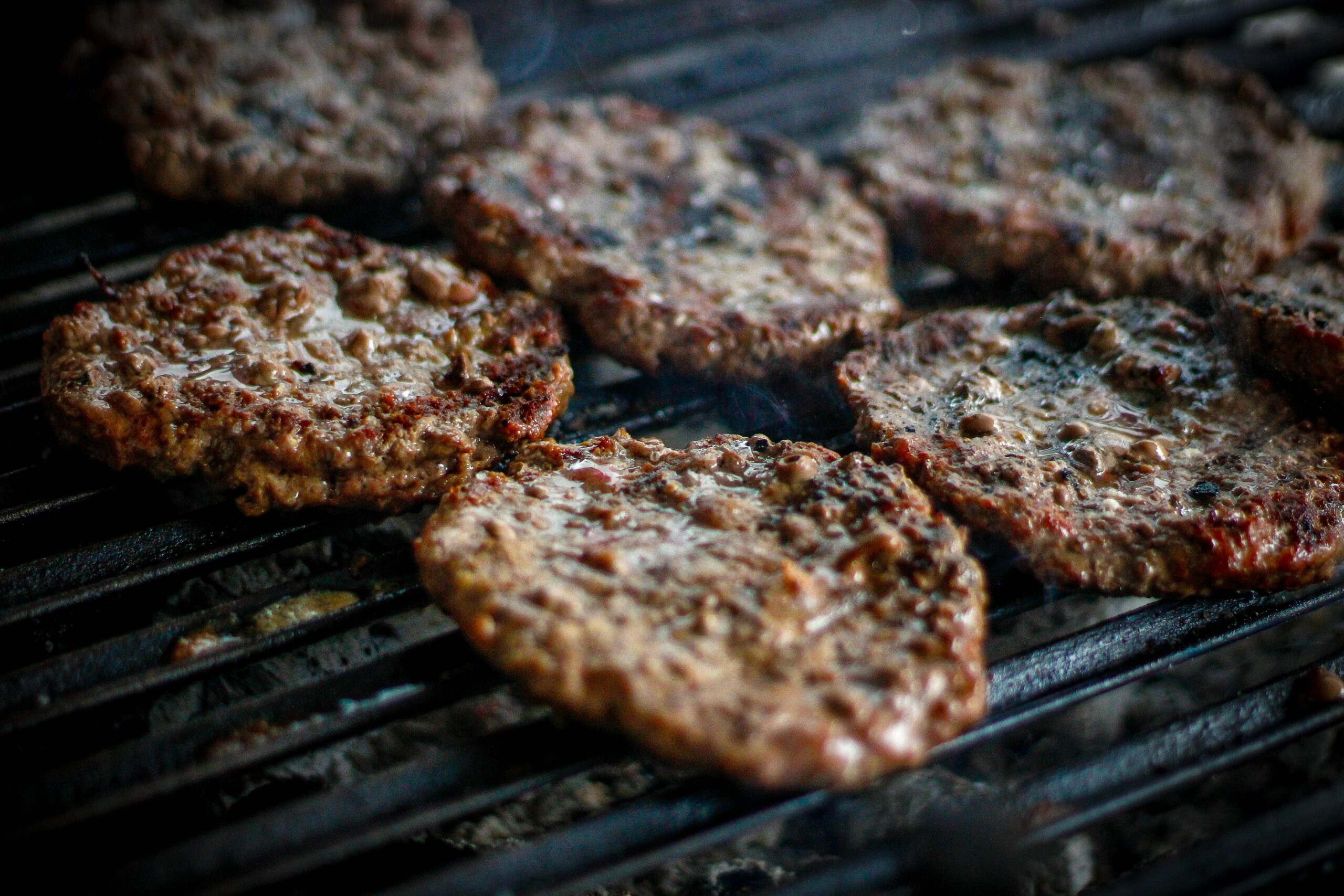
You place a large burger in the pan and a few minutes later it looks considerably smaller. That is not automatically a sign of poor meat or proof that water has been added. Burgers shrink because heat changes muscle proteins, drives out some water and melts part of the fat. Some reduction is unavoidable.
The useful question is how to separate normal shrinkage from factors that exaggerate it. Fat level, doneness, temperature, thickness, pressing and even how aggressively the mince was mixed all change the result.
What happens to muscle proteins during cooking?
Meat consists of muscle fibres containing water and proteins. As temperature rises, those proteins denature and contract. That contraction reduces the space available to hold water within the muscle structure.
Some liquid moves to the surface or into the pan. At the same time, the burger changes geometry: it normally loses diameter and can bulge in the middle if contraction is uneven.
Fat also leaves the burger
A blend containing fat provides flavour and succulence, but some of that fat renders during cooking. Part remains between the fibres while another part moves onto the griddle or pan.
A fattier burger can therefore show more visible volume loss than a very lean one. Removing all fat is not the solution, however: an excessively lean burger can become dry and less flavourful.
More cooking means more loss
The longer and more intensely meat is heated, the greater protein contraction becomes and the more moisture can be lost. This is why a heavily cooked burger is commonly smaller and firmer than one exposed to less heat.
With minced meat, however, food safety takes priority over chasing a rare centre. Grinding can distribute microorganisms from the outside of a whole piece throughout the mixture. Minced beef therefore needs safe, even cooking, especially for children, older adults, pregnant people and anyone with reduced immunity.
Does excessively high heat increase shrinkage?
Strong heat is useful for browning, but an extremely hot surface for too long can accelerate moisture loss at the exterior and burn it before the centre is properly cooked.
The answer is not always low heat. A good burger needs browning. Match heat and time to thickness: a thin patty tolerates fast, hard cooking, while a thick burger needs greater control so the centre can progress without charring the outside.
Pressing does not prevent shrinkage
A common mistake is repeatedly pressing a traditional burger with the spatula while it cooks. That pressure can squeeze out liquid and rendered fat that would otherwise remain in the patty for longer.
There is one important exception: a smash burger uses deliberate pressure right at the beginning, when a ball of meat hits a very hot flat surface. That creates a thin patty with maximum contact and an intense crust. It is not the same as repeatedly squeezing a thick burger during cooking.
Why do some burgers dome in the centre?
On a thick burger, the edges can contract rapidly while the centre retains more volume. The patty then arches into a dome. This is geometry, not necessarily poor quality.
Making the raw patty slightly wider than the bun and creating a shallow central indentation can help it finish flatter. The indentation does not stop weight loss; it simply compensates for the tendency to bulge.
Overmixing changes texture
Working mince aggressively, especially with salt, extracts proteins that make the mixture sticky and dense. That property is useful in some sausages but is not normally what we want from a loose-textured burger.
Handle the meat only enough to form a cohesive patty. There is no need to knead it for minutes as if making bread.
Initial size should anticipate contraction
If you want the cooked patty to cover the bun, do not form it at exactly the bun diameter and expect it to stay there. Making it slightly wider at the start compensates for normal shrinkage.
The exact amount depends on blend and technique, so learning how your particular mince behaves is more useful than relying on one universal percentage.
Does frozen meat shrink more?
Not necessarily just because it was frozen. What matters is how it was frozen, thawed and handled. Poor freezing can damage structure and increase drip during thawing, while properly frozen and thawed meat can still produce an excellent burger.
Do not cook a partially thawed burger using exactly the same timing as a chilled one and expect identical results. Its internal temperature distribution is different.
Do breadcrumbs or egg reduce shrinkage?
A pure beef burger and a meatball-style mixture are different foods. Breadcrumbs, egg, milk and other additions change the matrix, water retention and texture. They can alter shrinkage, but they also alter the product itself.
If the goal is a clean beef burger, it is better to solve size and juiciness through good meat, a sensible fat level and technique rather than adding ingredients only to make the patty appear larger.
Pan liquid is not a quality test
Seeing water and fat on the cooking surface does not prove the meat is poor. Meat naturally contains water, and any burger containing fat will release some as it heats.
Extreme loss can relate to composition, cooking or handling, but diagnosing fraud by looking at the pan alone is not technically sound.
How to reduce shrinkage without ruining the burger
- Do not overwork the mince: use minimal handling.
- Form it slightly wider than the bun: anticipate contraction.
- For a thick burger, add a shallow centre dimple: it helps control doming.
- Do not repeatedly press with the spatula: except for the initial smash technique.
- Match heat to thickness: strong browning without burning before the centre cooks.
- Do not chase zero shrinkage: some is a normal consequence of cooking meat.
Traditional and smash burgers pursue different shapes
A thick traditional burger aims to preserve a substantial interior and balance crust with centre. A smash burger deliberately maximises browned surface and minimises thickness. Comparing them only by how much they shrink misses the fact that they have different culinary goals.
Our beef cut guide explains how muscle structure determines cooking technique. Once meat is minced, that structure has been fragmented, making blend, fat and handling even more important.
Frequently asked questions
Does heavy shrinkage prove water was added?
No. Meat naturally contains water and cooking expels some of it. Fat content and final doneness also affect shrinkage.
Should I pierce a burger?
There is no useful reason to do so, and piercing can create paths for juices to escape. A spatula is enough.
Why make a dimple in the centre?
It compensates for the tendency of some thick patties to dome. It does not prevent all water or fat loss.
Does a smash burger shrink too?
Yes, but because it is very thin and pressed at the beginning, its shape changes differently. Its main goal is maximum browned surface.
Browse the meat and burgers currently available at El Mercado de Origen.
-
Sale!
 Select options
This product has multiple variants. The options may be chosen on the product page
Select options
This product has multiple variants. The options may be chosen on the product page


 Beef picanha (rump cap)