Introduction
November marks the beginning of the olive harvest in the Córdoba countryside. The ideal harvest date depends on the year, the weather and the variety. We assess ripeness both in the grove and through daily laboratory checks, including acidity and oil yield.
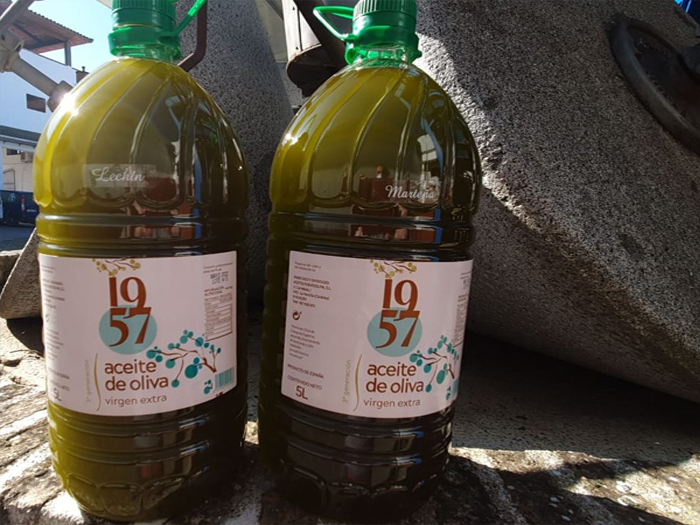
Our harvest generally runs from November to February. Arbequina is usually the first variety to be picked, followed by Marteña or Picual and, depending on the grove, other traditional varieties. Yield varies from season to season: what matters is not only how much oil the fruit contains, but the quality and sensory profile of the oil obtained.
Harvesting the olives
The harvest combines manual work and mechanical assistance. Teams spread nets beneath the trees, shake or comb the branches and use trunk or branch vibrators where appropriate. The olives are collected quickly and taken to the mill so that milling can begin while the fruit is fresh.
The objective is to reduce the time between tree and mill and protect the fruit from unnecessary damage, heat and oxidation.
How extra virgin olive oil is made
At the mill the olives are cleaned, milled into a paste, slowly mixed so the oil droplets can join together, and then centrifuged to separate oil from vegetation water and pomace. Temperature and time are carefully controlled. Once separated, the oil may be filtered immediately or bottled unfiltered for a limited period after harvest.
Olive varieties and their character
Arbequina
Arbequina generally produces a mild, sweet and delicate oil with fresh fruity aromas. It is a good choice for dressings, toast, mild sauces, fish and baking, and is often an easy introduction to extra virgin olive oil for people who prefer less bitterness and pungency.
Manzanilla
Manzanilla is best known as a table olive, but it can also produce distinctive oils with a balanced profile, green-fruit notes and good culinary versatility.
Picual (Marteña)
Picual is one of Spain’s great oil varieties and is especially important in Andalusia. Its oils tend to be more intense, with green, herbaceous notes and a characteristic balance of bitterness and pungency. Its naturally high oleic-acid and polyphenol content also gives it excellent stability.
Lechín
Lechín is a traditional Andalusian variety, often found in old dry-farmed groves. Its oils can be intensely fruity, with green-leaf and tomato-plant notes and a pronounced bitter and peppery finish.
As a simple guide to intensity, Arbequina and Manzanilla tend to be softer, while Picual and Lechín are usually more robust. Every harvest is different, so the final profile always depends on the fruit and the season.
Filtered or unfiltered?
Filtered oil
Filtering removes most suspended particles and residual moisture. The result is visually clearer and usually more stable for longer storage.
Unfiltered oil
Fresh unfiltered oil contains tiny particles from the olive and has a cloudier appearance and particularly vivid early-harvest character. Over time those particles settle naturally. We therefore offer unfiltered oil only for a limited period after harvest, when it is at its best.
Neither style is automatically better: the key is freshness, correct storage and choosing the profile you enjoy.