In everyday Spanish, people often use verduras for almost everything in the vegetable section: tomatoes, onions, carrots, lettuce, peppers and courgettes. That usage is normal and easily understood. In a more precise Spanish food-classification sense, however, verdura and hortaliza are not exactly identical.
The Spanish Food Code uses hortaliza as a broad term for edible horticultural herbaceous plants that can be eaten raw or cooked. Within that broad group, verdura refers more specifically to products in which the edible part is made up of green organs such as leaves, stems or inflorescences.
Quick answer
In the technical sense used by the Spanish Food Code, verduras are a group within hortalizas, but not every hortaliza is a verdura. Lettuce and spinach fit the narrower idea very clearly. Onion, carrot and aubergine are hortalizas, although everyday Spanish speakers commonly call them verduras too.
This difference is mainly useful when precision matters. In cooking and ordinary conversation, verdura has a much broader meaning.
What is a hortaliza?
Hortaliza works as an umbrella category for edible horticultural plants from which we eat different structures: leaves, stems, roots, bulbs, flowers or inflorescences, and culinary fruits.
This is why foods as different as lettuce, onion, garlic, leek, carrot, pepper, aubergine, courgette, broccoli and cauliflower can all belong to the broad horticultural group.
What is a verdura?
In the stricter Spanish definition, a verdura is a hortaliza whose edible part is especially associated with green plant organs. The Food Code refers to leaves, stems and inflorescences.
Clear examples include lettuce, spinach, chard and endive. Everyday culinary language extends the word much further, which is why strict technical usage and ordinary speech do not always match.
Are broccoli and cauliflower verduras?
They are hortalizas and we mainly eat their inflorescences. The Spanish Food Code includes inflorescences within its concept of verdura, even though cauliflower is not green. This shows why colour alone is not a reliable classification rule.
What about tomatoes?
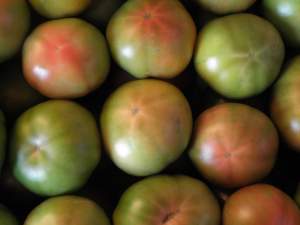
Tomatoes are a classic source of confusion. Botanically, the tomato is a fruit because it develops from a flower and contains seeds. In horticultural and culinary classification it can simultaneously be a fruit-type hortaliza.
There is no contradiction. “Fruit” describes a botanical structure, while hortaliza is an agricultural and food-use category.
Peppers, aubergines and courgettes
The same logic applies to peppers, aubergines, courgettes and pumpkins. Botanically they are fruits; in cooking they are savoury plant foods and within horticultural classification they are treated as hortalizas.
Saying that a tomato is botanically a fruit therefore does not mean it has to disappear from the vegetable aisle.
Onion, garlic and leek
Onion and garlic are good examples of hortalizas that do not fit the narrow mental image of leafy “greens”. The Spanish Food Code groups them among bulbs. Leek also belongs within the broader horticultural family.
In a recipe, however, the instruction “cook the verduras” may perfectly well include onion and leek. Culinary context is broader than formal classification.
Carrots and other roots
Carrot is a root hortaliza. Again, no one needs to correct ordinary speech if a cook calls carrots “verduras”, but when classifying edible plant structures, a root is different from a green leaf or stem.
Are potatoes hortalizas?
The potato is a tuber, specifically a modified underground stem. It is commonly sold and discussed alongside hortalizas, although its high starch content means that many nutritional systems treat it differently from non-starchy vegetables.
This illustrates an important principle: botanical, culinary and nutritional classifications do not always line up.
What about pulses?
The Spanish Food Code distinguishes fresh pulses—immature fruits and seeds of leguminous horticultural plants—within horticultural produce. Dried chickpeas, lentils and beans are generally treated as their own food category because their composition, storage and cooking are very different.
A fresh pea can therefore appear in a vegetable context while a dried chickpea is discussed as a pulse.
Examples by edible plant part
- Leaves: lettuce, spinach, chard, endive.
- Stems: celery and other tender stems.
- Inflorescences: broccoli, cauliflower.
- Bulbs: onion, garlic.
- Roots: carrot, radish.
- Culinary fruits: tomato, pepper, aubergine, courgette.
- Tubers: potato, with its own nutritional particularities.
Why shops use broad “vegetable” language
Retail categories need to be intuitive. The familiar Spanish expression “frutas y verduras” groups a huge range of produce in a practical way. Forcing shoppers to navigate separate sections for roots, bulbs, inflorescences and horticultural fruits would add complexity without helping most purchases.
How we use the terms at El Mercado de Origen
In a food shop, both Spanish terms can coexist naturally. Hortalizas is the more precise umbrella term, while verduras is the word many shoppers type and say when looking for the same products.
For practical advice about seasonality, storage or cooking, the specific product usually matters more than the linguistic label.
Fresh, frozen or preserved does not change the category
Whether a hortaliza is sold fresh, frozen or preserved describes its presentation and storage, not a different botanical identity. See our guide to fresh vs frozen vegetables for the practical differences between those formats.
The easiest way to remember it
Use this simple rule: hortaliza is the broad Spanish umbrella term; verdura can be a narrower subgroup even though ordinary speech often uses it as a synonym. Then, when needed, classify the edible part as leaf, stem, inflorescence, bulb, root, fruit or tuber.
Bottom line
Verdura and hortaliza overlap but are not identical in technical Spanish usage. The Spanish Food Code uses hortaliza as the general category and verdura for certain hortalizas whose edible organs are mainly leaves, stems or inflorescences. Everyday Spanish is broader, so tomatoes, onions and carrots are often called verduras in conversation even when hortalizas is the more precise umbrella term.

 100% beef burgers – gluten-free (2)
  Couples’ beef box